Executive summary
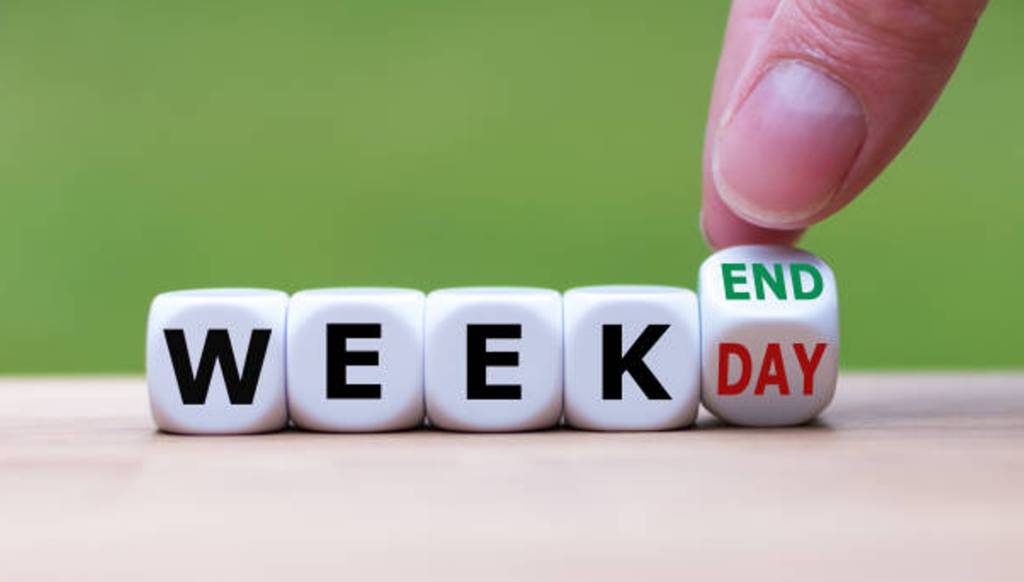
Weekend vs weekday sampling performance is one of the most important questions facing beverage brand managers and supplier leaders as in-store activations become more tightly tied to measurable retail outcomes.
For beverage brands investing in in-store trial, the debate around weekend vs weekday sampling is no longer about convenience—it is about performance, conversion quality, and retail alignment. While weekends typically deliver higher shopper volume, weekday activations often produce stronger category-qualified engagement and operational consistency. The brands that outperform treat day-of-week as a strategic variable—supported by retailer context, distributor coordination, and execution data—not as a fixed scheduling habit.
Why the weekend vs weekday sampling question matters
Sampling is one of the few activation tactics that directly influences product trial at shelf. However, most programs still default to weekends without evaluating whether that timing aligns with:
- shopper intent,
- category purchase behavior,
- store labor dynamics, and
- execution quality.
Industry estimates (based on field benchmarking and trade survey averages):
- Weekend demos typically deliver 30–50% higher raw shopper traffic than weekday shifts.
- Weekday demos often generate 10–20% higher qualified engagement rates (defined as shoppers who stop, interact, and discuss purchase use cases).
- Conversion outcomes vary significantly by category and retailer format.
The question is not which day performs better in isolation—but which day performs better for your product, category role, and retail environment.
How retailer context shapes weekend vs weekday sampling performance
Day-of-week performance cannot be evaluated without understanding the operating model of the retailer.
This is especially true in large national and regional grocery and beverage retailers such as Kroger, H-E-B, and specialty beverage chains like Total Wine & More.
Each environment brings different shopper missions, traffic peaks, and operational constraints.
Weekend sampling: high volume, higher variability
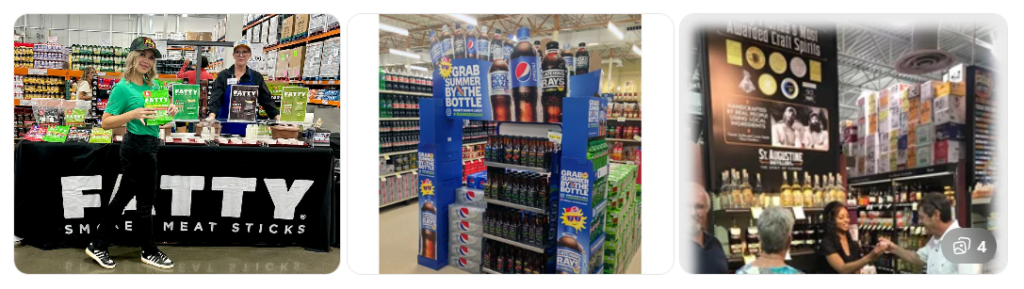
Weekend sampling remains the most common activation window for a reason—traffic.
Where weekend sampling performs best
Weekend shifts are typically most effective when:
- the product targets broad household shoppers,
- the brand is driving top-of-funnel trial,
- and the category supports impulse or occasion-driven purchases.
Examples include:
- ready-to-drink cocktails and seltzers,
- flavored malt beverages,
- emerging functional beverages.
Strengths of weekend activations
- Larger audience reach
- Higher sample throughput
- Strong visibility for new launches and resets
Common weekend execution risks
- Congested aisles and traffic bottlenecks
- Shorter engagement windows per shopper
- Higher likelihood of out-of-stock or shelf disruption
- Less access to store leadership during peak hours
Real-world example (generic):
A canned spirits brand executed Saturday demos near a front cross-aisle. While engagement volume exceeded weekday shifts by more than 40%, ambassadors reported that many shoppers were rushing and unable to discuss flavor profiles or usage occasions—limiting deeper product education.
Key takeaway
Weekend sampling excels at reach and awareness, but performance becomes inconsistent if execution quality drops under traffic pressure.
Weekday sampling: lower volume, higher quality engagement
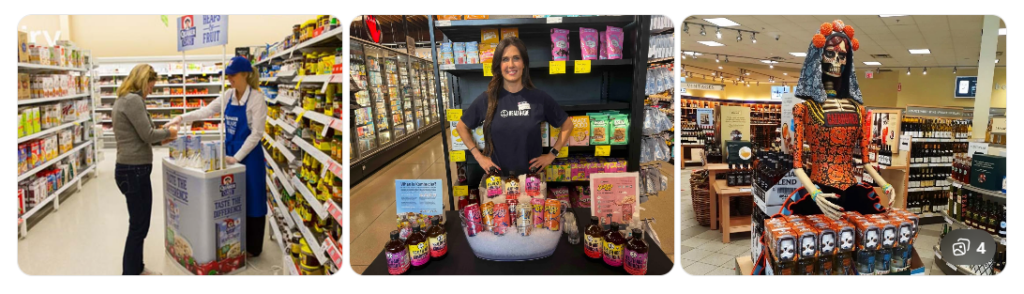
Weekday activations are often overlooked—but they offer meaningful advantages when aligned correctly.
Where weekday sampling performs best
Weekday shifts are particularly effective for:
- premium or higher-consideration beverages,
- non-alcoholic alternatives and functional products,
- emerging THC beverage formats (where regulations permit),
- brands requiring product explanation or usage education.
Strengths of weekday activations
- Longer, more focused shopper conversations
- Greater ambassador control of space and flow
- Easier compliance execution
- More access to store associates and managers
Industry estimate:
Weekday demos typically produce 15–25% longer average shopper interaction times than weekend shifts.
Real-world example (generic):
A non-alcoholic spirits brand shifted 40% of its demos to weekday afternoons. Although sample volume dropped, the brand recorded higher intent signals and stronger associate advocacy after demos, which supported follow-up selling by store staff.
Key takeaway
Weekday sampling is often better suited for conversion quality and education-led growth.
The biggest mistake: treating day-of-week as a universal rule
High-performing brands do not choose between weekend vs weekday sampling based on habit. They evaluate:
- category purchase cycles,
- shopper mission patterns,
- and store-level velocity.
Consider these variables before selecting your demo days
- Is your product typically purchased for:
- immediate consumption,
- planned social occasions,
- or routine household use?
- Does your category rely more on:
- impulse behavior, or
- reassurance and explanation?
- Are you launching, expanding distribution, or defending shelf space?
These questions matter more than traffic volume alone.
Category-driven decision framework
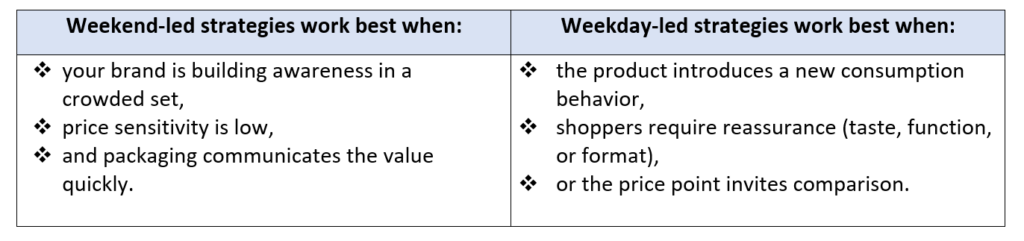
Many national brands now deploy hybrid schedules that intentionally combine both.
Why execution quality changes by day
Sampling performance is not only shopper-driven. It is operational.
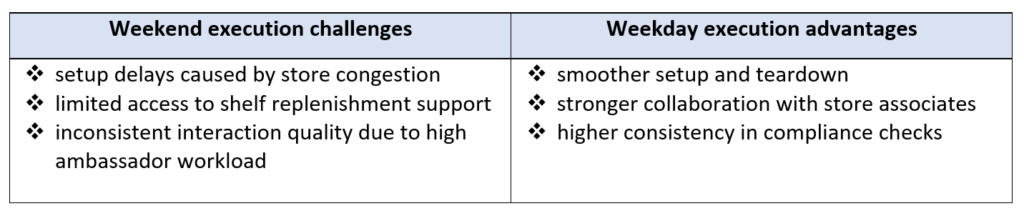
Operational insight:
Brands often underestimate how much execution reliability influences conversion—especially in regulated beverage categories.
Using data to determine what actually performs better
Most brands still measure:
- number of samples poured
- number of shifts completed
These metrics cannot explain whether weekend vs weekday sampling is driving real commercial value.
High-performing programs track:
- shopper engagement counts
- estimated intent or conversion indicators
- primary objections (price, flavor, function, format)
- shelf availability at time of demo
- associate feedback during and after shifts
Industry estimate:
Brands using structured field data to adjust day-of-week scheduling typically improve overall activation ROI by 10–18% over static schedules.
This is where technology-enabled activation becomes essential.
Distributor alignment changes the day-of-week outcome
Distributor sales teams operate on weekday rhythms.
When weekday demos are aligned with:
- account manager store visits,
- display builds,
- and follow-up order conversations,
sampling becomes directly connected to commercial execution.
Weekend-only strategies often miss this alignment opportunity.
Practical advantage
- weekday activations can support reorder conversations within 24–48 hours,
- store-level feedback is easier to circulate while teams are actively selling.
How technology-enabled activation supports smarter scheduling

As a technology-enabled activation partner and data-first sampling platform, Liquid to Lips Marketing supports brands by enabling:
- real-time visibility into shift performance
- standardized compliance documentation
- centralized market and store-level analytics
- comparative reporting across weekday and weekend activations
The strategic advantage is not simply running more demos—it is understanding which days produce better commercial signals across different markets and retail formats.
This insight allows brands to:
- rebalance schedules dynamically,
- validate retailer and distributor recommendations,
- and optimize investment by category and geography.
Actionable takeaways for beverage leaders
To determine whether weekend vs weekday sampling performs better for your brand:
- Analyze category behavior before setting schedules.
- Use a hybrid testing approach across matched stores and markets.
- Measure engagement and intent—not only samples poured.
- Evaluate execution quality by day-of-week.
- Align weekday demos with distributor selling calendars.
- Adjust timing by product lifecycle (launch vs expansion vs maintenance).
- Deploy technology that enables real-time performance comparison.
Conclusion: the better day is the one supported by data
Weekend vs weekday sampling is not a binary decision. It is a performance optimization problem.
Brands that rely solely on weekend volume often miss opportunities for deeper engagement, stronger associate advocacy, and better distributor alignment. Brands that test, measure, and rebalance activation timing based on real field data gain a measurable advantage in both conversion efficiency and execution reliability.
In today’s competitive beverage landscape, data-driven scheduling—supported by national execution partners and technology-enabled platforms—has become one of the most controllable levers for improving sampling performance.