Executive Summary
A strong beverage brand activation strategy determines how effectively a brand converts consumer awareness into repeat purchase. Event-based activations generate rapid exposure and buzz, while ongoing promotional programs build sustained market penetration and stronger sales conversion. Most successful beverage brands combine both approaches to balance visibility and long-term growth. Understanding when to deploy each strategy is critical for maximizing marketing investment.
The Activation Strategy Question Facing Beverage Brands
Beverage marketing has shifted dramatically over the past decade. Traditional advertising still plays a role, but in a highly competitive on-premise and retail landscape, direct consumer engagement often drives the most immediate trial and purchase behavior.
Brand managers and supplier sales teams increasingly ask the same strategic question:
Should we invest in large, event-based activations—or prioritize ongoing sampling programs that run week after week?
Both approaches can generate value. However, they achieve very different outcomes in terms of awareness, trial conversion, and long-term market penetration.
Understanding when to deploy each strategy—and how to measure results—is essential for efficient marketing spend.
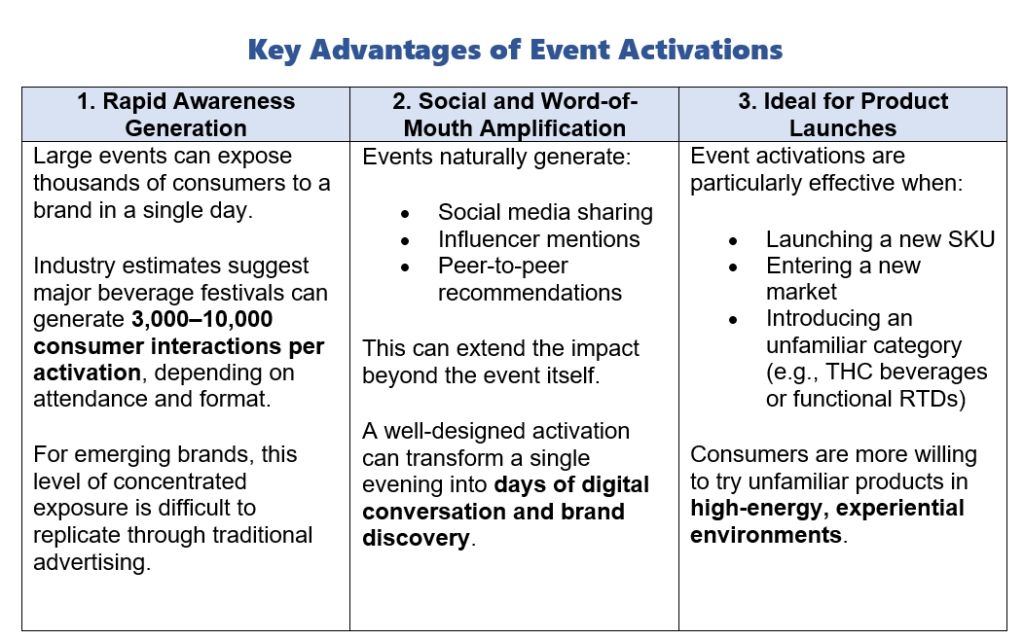
Event-Based Activations: High-Impact Brand Moments
Event-based activations are typically concentrated campaigns tied to festivals, sports events, major nightlife weekends, or seasonal moments.
Examples include:
- Sampling at large music festivals
- Sponsored activations at sporting events
- Holiday-themed bar takeovers
- Launch parties for new product releases
These programs create high-energy brand exposure within a short window of time.
Limitations of Event Activations
Despite their impact, event activations come with structural constraints.
Short lifespan
Most event activations last a few hours to a few days, limiting sustained exposure.
Lower repeat interaction
Consumers may try the product once, but without ongoing reinforcement, repeat purchase can drop quickly.
Higher cost per interaction
Large events often include:
- Sponsorship fees
- Production costs
- Staffing and logistics
As a result, cost per sample can be significantly higher compared with recurring programs.
Ongoing Activation Programs: Building Market Penetration
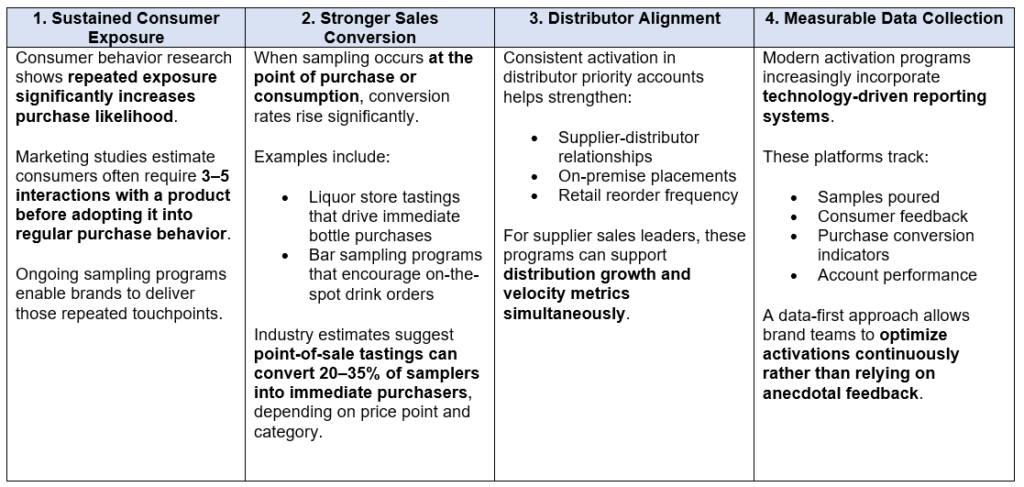
Ongoing programs focus on consistent in-market engagement over weeks or months rather than one-time events.
These programs typically operate in:
- Bars and restaurants
- Liquor stores
- Grocery retail locations
- Nightlife venues
- distributor priority accounts
Rather than large bursts of exposure, they emphasize steady consumer trial and repeat visibility.
Key Advantages of Ongoing Programs
The Real Strategy: Events Drive Awareness, Ongoing Programs Drive Sales
The most effective beverage marketing strategies rarely rely on a single activation model.
Instead, successful brands combine event-based awareness with sustained in-market engagement.
Example: Emerging RTD Cocktail Brand
Phase 1: Event Activation
- Launch at a regional music festival
- 5,000 consumer interactions
- Significant social media exposure
Goal: introduce the brand to the market
Phase 2: Ongoing Market Activation
- Weekly bar sampling across 25 accounts
- Retail tastings in priority liquor stores
- Distributor-supported promotions
Goal: convert awareness into repeat purchases
This layered strategy creates both visibility and velocity, which are essential metrics for distributor support and retail expansion.
When to Use Event-Based Activations
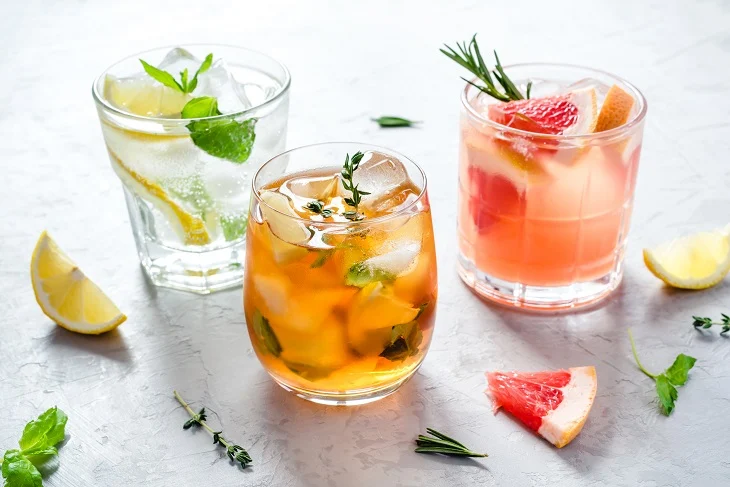
Event-based activations are most effective when brands want to:
- Generate rapid awareness in a new market
- Launch new products or flavors
- Create press or social media buzz
- Reach large audiences quickly
- Build brand identity and lifestyle positioning
For early-stage brands, events can act as accelerators for initial market entry.
When Ongoing Programs Deliver Better ROI
Ongoing programs typically outperform events when brands need to:
- Increase sales velocity
- Support existing distribution
- Build repeat purchase behavior
- Strengthen relationships with on-premise accounts
- Provide consistent sampling opportunities
In many cases, these programs deliver lower cost per consumer interaction while producing more measurable sales outcomes.
The Growing Role of Data in Activation Strategy
Historically, beverage activations were difficult to measure beyond anecdotal feedback.
Today, brands increasingly expect quantifiable performance metrics, including:
- Samples distributed
- Estimated conversion rates
- Market penetration by account type
- Consumer sentiment and feedback
Technology-enabled activation platforms now allow brand teams to capture real-time insights from field programs.
These insights help answer critical questions such as:
- Which venues generate the highest trial rates?
- Which markets produce the strongest repeat purchase?
- Which products resonate with specific demographics?
This shift toward data-driven sampling is changing how beverage companies allocate activation budgets.
Strategic Takeaways for Beverage Brand Leaders
For brand managers, supplier executives, and emerging founders, several principles consistently drive stronger activation outcomes:

Conclusion
Event-based activations and ongoing promotional programs each play a valuable role in beverage marketing—but they serve different strategic purposes. Events create high-impact awareness and brand energy, while ongoing programs build sustained consumer engagement and measurable sales growth.
For beverage companies operating in increasingly competitive markets, the most effective strategy blends both approaches while leveraging technology and data to measure real-world performance.
Activation is no longer just about pouring samples—it’s about capturing insights, optimizing programs, and turning consumer trial into lasting brand adoption.