
How beverage brands can prove real sales impact from sampling and in-store programs
Executive summary
Measuring incremental lift after a retail activation is one of the most important ways beverage brands can validate the real business impact of in-store sampling and experiential marketing programs. While retail activations continue to influence shopper behavior, brand and sales leaders now require clear, data-driven methods to quantify how much incremental revenue those activations truly generate.
Why incremental lift matters more than activity metrics
Most beverage activations are still evaluated using operational metrics:
- Number of demos executed
- Samples poured
- Stores covered
- Hours worked
These metrics describe effort, not impact.
Incremental lift answers a much more important question:
How much additional revenue did this activation actually generate?
For brand managers, supplier sales leaders, and distributor executives, incremental lift connects field execution directly to:
- Retail performance
- Trade investment ROI
- Distribution and display strategy
- Account-level growth conversations
In a category where trade spend continues to rise while shelf competition intensifies, the ability to isolate real sales impact is becoming a strategic requirement—not a nice-to-have.
What “incremental lift” actually means in retail activation
Incremental lift is the difference between actual sales during or after an activation and what sales would have been without that activation.
In practical terms:
Incremental Lift = Activated Store Sales – Expected Baseline Sales
The challenge is not calculating the difference.
The challenge is accurately defining the baseline.
The most common mistake: comparing week-over-week sales
A simple before-and-after comparison often looks like this:
- Week before activation: 10 cases
- Activation week: 16 cases
- Lift assumed: +6 cases
This approach is easy—but flawed.
It ignores:
- Seasonality
- Promotions or price changes
- Nearby marketing activity
- weather-driven demand shifts
- account-specific traffic changes
For beverage brands operating at scale, this creates inflated or misleading performance reporting.
A practical framework for measuring incremental lift

1. Establish a true baseline
The strongest baseline uses one or both of the following:
A. Historical store trend modeling
This uses multiple weeks of prior sales to establish expected volume for the activation window.
Typical inputs:
- 6–12 weeks of pre-activation sales
- distribution stability
- pricing consistency
- promotion flags
B. Matched control stores
Select a group of similar stores that:
- did not receive the activation
- carry the same SKU set
- share similar sales velocity and demographics
The control group becomes your real-world benchmark.
This is especially valuable for:
- large chains
- national programs
- distributor-driven activation waves
2. Define the correct measurement window
Not all lift occurs on the day of sampling.
For most beverage activations, lift typically appears in two windows:
- Immediate lift: same day or same week
- Halo lift: 1–3 weeks following activation
Light industry estimates suggest that 20–40% of total incremental volume from sampling programs occurs after the activation date, not during it (estimate based on aggregated agency and retail program reporting across alcohol and beverage categories).
If your reporting window only covers the activation day, you are undercounting true impact.
3. Segment by store, not just program average
Program averages hide the operational reality.
To improve future planning, lift should be analyzed by:
- store tier (A/B/C velocity)
- format (grocery, liquor, mass, club, convenience)
- on-premise-adjacent vs destination retail
- region and distributor
This reveals:
- where activation works best
- where staffing models should change
- where pricing or display alignment matters more than sampling
4. Control for price and promotion effects
If a SKU is on feature, TPR, or display during activation, lift must be adjusted.
Attribution should separate:
- base promotional lift
- incremental experiential lift
Without this separation, sampling may incorrectly receive credit for what pricing drove.
A modern measurement model typically tags:
- promo flags
- feature support
- endcap or stack presence
and includes those as variables in the baseline.
What data is realistically required?
Contrary to common belief, you do not need perfect data to build reliable lift models.
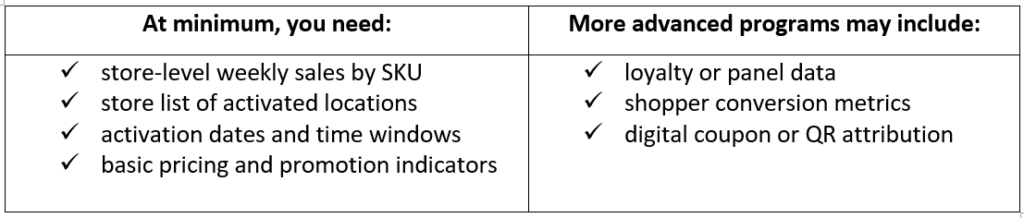
The key is not volume of data.
It is alignment between execution data and sales data.
This is where many activation programs fail.
When field execution data is collected manually, late, or inconsistently, it becomes very difficult to match what actually happened in-store to what appears in retail reporting.
Technology-enabled activation platforms that capture execution details in real time significantly reduce this gap and improve the reliability of post-program measurement.
Real-world example: a regional spirits sampling program
A regional spirits supplier ran a 120-store weekend sampling program across two states.
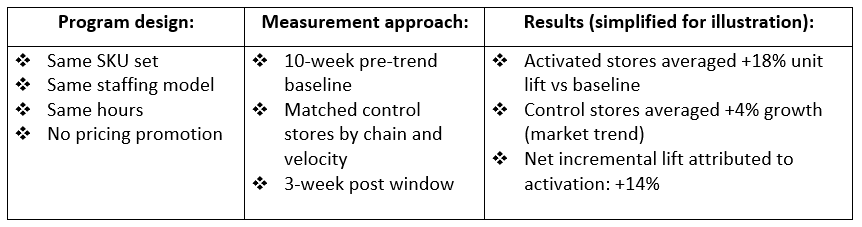
More importantly, when segmented:
- high-volume suburban stores delivered nearly 2x the lift of urban small-format locations
- Friday evening activations outperformed Saturday midday by a meaningful margin
The outcome was not just ROI validation—it directly reshaped future route planning and staffing strategy.
Estimating ROI from incremental lift
A simple executive-level ROI view can be calculated as:
Incremental units × gross margin – activation cost
Example:
- Incremental units: 1,200 bottles
- Average contribution margin per bottle: $6 (estimate)
- Gross incremental margin: $7,200
- Program cost: $5,000
- Net return: $2,200
This does not include longer-term brand equity or repeat purchase.
It gives leadership something they rarely get from field marketing: a financial signal tied to execution.
Why execution quality directly impacts lift
Not all sampling programs are equal—even with identical plans.
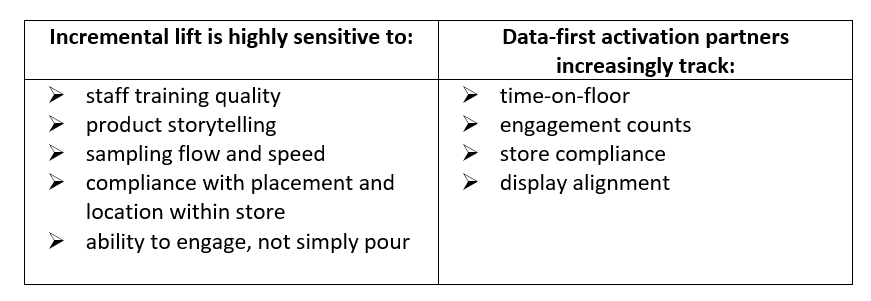
When these execution signals are tied back to store-level lift, brands can finally understand which operational behaviors actually drive conversion.
This is where the role of a national execution partner becomes strategic rather than logistical.
How Liquid to Lips fits into a modern measurement model
Liquid to Lips operates as a technology-enabled activation partner built specifically for beverage brands that need scalable execution and reliable performance data.
Rather than treating sampling as a standalone service, Liquid to Lips functions as:
- a data-first sampling platform
- a national execution partner across spirits, wine, beer, and emerging THC beverages
- a field network designed to integrate execution data directly into post-program performance analysis
This structure allows brand and sales teams to:
- validate which activations actually move volume
- compare performance across regions and distributors
- continuously improve route design and store targeting
The value is not in producing more reports—it is in producing cleaner inputs that make lift measurement credible.
Actionable takeaways for beverage leaders
If your organization runs retail activations today, start with these steps:
- Move beyond single-week comparisons.
Always include a post-activation window. - Introduce control stores for large programs.
Even a small control group improves confidence dramatically. - Segment lift by store type and region.
Use results to optimize where you activate—not just how often. - Align execution data with sales data.
Ensure your activation partner captures accurate store, date, and time details. - Track execution quality signals.
Staffing quality and compliance often explain more variance than store traffic. - Build ROI views executives can trust.
Focus on incremental units and contribution margin, not impressions.
Conclusion: lift measurement turns activations into growth strategy
Retail activations remain one of the few moments when beverage brands directly influence shoppers at the point of decision. But without credible incremental lift measurement, activations remain an operational expense rather than a strategic growth lever.
By combining disciplined baseline modeling, properly designed control groups, and accurate execution data, brands can finally answer the most important question in field marketing:
Did this program create sales we would not have otherwise earned?
For brands working with technology-enabled, data-first partners such as Liquid to Lips, activation measurement becomes not just a reporting exercise—but a continuous improvement engine that strengthens retail strategy, distributor alignment, and long-term brand performance.