
Executive Summary
Sampling vs Digital Ads for Beverage ROI is one of the most common budget questions facing beverage brand leaders today. As spirits, wine, beer, and THC beverage categories become more competitive, marketing teams must decide how to balance experiential activations with digital media investments to drive measurable, scalable return.
The ROI challenge in beverage marketing
Unlike many consumer categories, beverage purchase decisions are:
- Sensory-driven (taste, aroma, mouthfeel)
- Highly competitive at shelf
- Heavily influenced by availability and on-premise exposure
- Often constrained by advertising and platform rules
At the same time, marketing leaders are under pressure to show:
- Clear attribution
- Sales lift
- Distributor and retail alignment
- Repeatable, scalable growth programs
This makes the question of sampling vs. digital advertising ROI especially important for beverage brand managers and supplier sales leaders.
Understanding what “ROI” really means for beverage brands

Before comparing channels, it’s important to clarify how ROI is typically evaluated in beverage marketing.
In practice, ROI usually includes:
- Incremental sales or depletion lift
- Cost per trial or conversion
- Impact on velocity at participating accounts
- Contribution to distributor pull-through
- Long-term brand adoption and repeat behavior
Not all of these metrics are equally measurable in every channel.
Digital ads in beverage marketing: strengths and limitations
Where digital advertising performs well
Digital advertising remains valuable for:
- Brand awareness and reach
- Retargeting known consumers
- Supporting launches and promotions
- Driving traffic to: store locators, brand websites, and ecommerce or DTC platforms (where legal)
Common formats include:
- paid social
- programmatic display
- search
- influencer amplification
Estimated benchmarks (industry estimates, 2024):
- Average paid social CTR for beverage brands: 0.8%–1.2%
- Estimated conversion to purchase from ad exposure: 1%–3%
- Cost per thousand impressions (CPM): $8–$18
(Estimates vary significantly by platform, geography, and targeting.)
The structural limitation for beverages
Digital ads do not solve the core barrier for beverage adoption:
Consumers cannot taste your product.
For most beverage categories, especially:
- craft spirits
- premium RTDs
- functional or THC beverages
- new flavor innovations
the primary reason for hesitation is uncertainty around taste and experience.
Digital ads communicate positioning.
They do not remove trial risk.
Attribution challenges
Even with strong digital infrastructure, beverage brands still struggle with:
- limited visibility into offline retail conversion
- delayed purchase cycles
- distributor-managed fulfillment
- fragmented point-of-sale data
As a result, many digital campaigns measure ROI through:
- impressions
- engagement
- traffic
rather than verified product trial or purchase.
Sampling: a fundamentally different growth mechanism

Sampling operates on a different commercial logic.
Instead of influencing consideration, sampling creates product experience.
Why sampling is uniquely powerful for beverages
Sampling addresses three core barriers simultaneously:
- taste uncertainty
- brand unfamiliarity
- purchase hesitation
When executed well, sampling produces:
- immediate trial
- emotional engagement
- higher confidence at shelf or bar
Estimated industry benchmarks (sampling programs, multi-category estimates):
- Trial-to-purchase conversion within 7–14 days: 15%–35%
- Purchase intent after tasting: 60%+
- Lift in velocity at activated locations: 10%–30%
(Estimates based on agency-reported programs and syndicated event marketing studies.)
Sampling ROI: what actually drives results

1. Conversion Quality
A sampled consumer is not just aware—they are informed by experience.
Compared to digital ad engagement:
- sampling converts fewer people
- but converts them at much higher probability
This matters in:
- highly competitive retail sets
- crowded RTD and ready-to-drink shelves
- regional brand expansion
2. Sales enablement for distributors
Sampling does not only influence consumers.
It directly supports:
- distributor sales presentations
- retail buyer conversations
- chain authorization and expansion
When sales teams can demonstrate:
- documented trial volume
- store-level performance
- consumer feedback
their conversations shift from concept to proof.
The hidden risk of underperforming sampling programs

Sampling does not automatically deliver ROI.
The biggest reasons sampling fails are:
- lack of location strategy
- no demographic targeting
- inconsistent brand representation
- no data capture
- no integration with sales planning
This is why the operational model matters as much as the activation itself.
Modern programs require:
- digital field reporting
- geo and account-level performance tracking
- standardized execution
- integration into broader marketing and sales dashboards
This is where technology-enabled sampling platforms now differentiate serious programs from legacy street-team approaches.
Comparing ROI: sampling vs digital ads
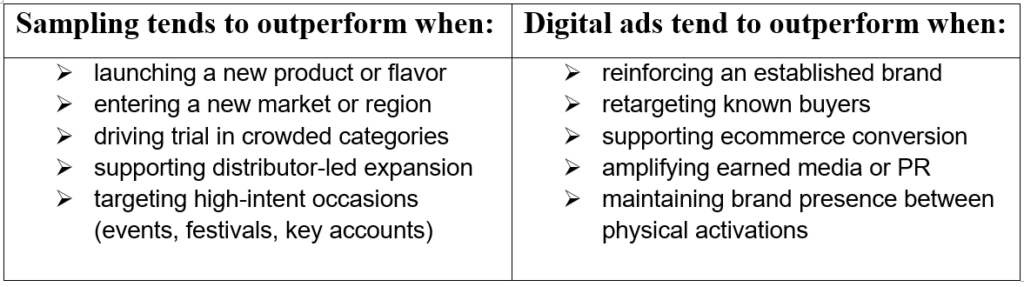
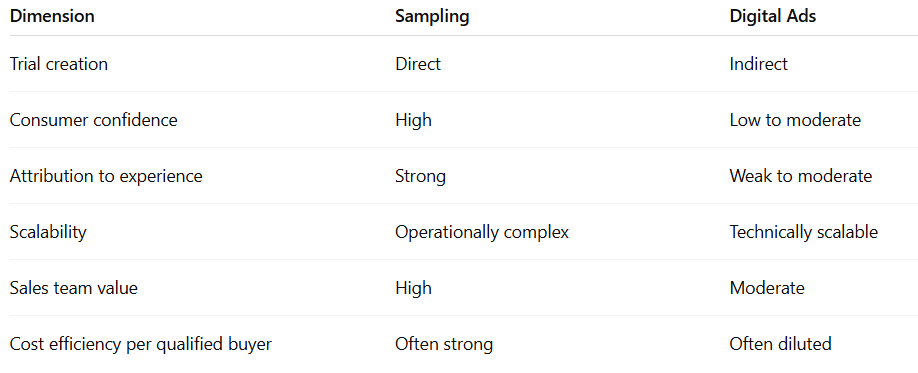
A practical ROI comparison
Real-world scenario: emerging RTD brand expansion
An emerging RTD brand launching in three metro markets may face:
- limited brand recognition
- crowded shelf sets
- distributor pressure for early velocity
A purely digital launch may generate:
- website traffic
- social engagement
- early awareness
But without trial, retailers still rely on:
- category performance
- rep recommendations
- competitive benchmarks
In contrast, a targeted sampling program:
- activates high-traffic on- and off-premise locations
- gathers structured consumer feedback
- tracks account-level results
- feeds data directly into distributor sales decks
The result is not just consumer demand—but commercial leverage.
Why integrated programs outperform channel silos
The most effective beverage marketing strategies today integrate both channels.
Sampling generates:
- audiences
- behavior signals
- geographic performance insights
Digital then amplifies:
- post-trial reminders
- brand storytelling
- repeat consideration
- store locator usage
This creates a closed-loop system:
- Experience
- Reinforcement
- Re-engagement
The role of data-first sampling platforms
Modern beverage sampling is no longer only about brand ambassadors and tasting tables.
Leading programs operate as:
- technology-enabled activation platforms
- real-time reporting environments
- standardized national execution systems
For multi-market brands, this enables:
- consistent brand delivery
- comparable results across regions
- reliable insights for sales and marketing alignment
Liquid to Lips Marketing operates in this model—combining national execution with data infrastructure that allows sampling to function as a measurable, scalable growth channel rather than a one-off promotional tactic.
This data-first approach supports:
- smarter location selection
- better audience targeting
- clearer ROI reporting for leadership teams
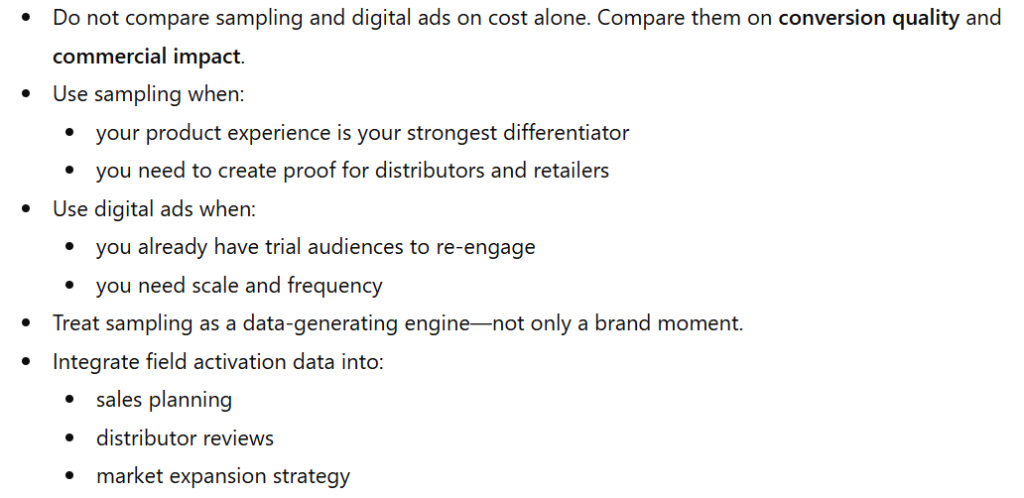
Actionable takeaways for beverage leaders
Conclusion: ROI is built through experience, then amplified by media
In beverage marketing, ROI is not created by awareness alone.
It is created when consumers confidently choose your product—repeatedly—within a highly competitive retail and on-premise environment.
Sampling delivers the most direct path to that confidence.
Digital advertising delivers scale, reinforcement, and continuity.
The brands generating the strongest long-term returns are not choosing between channels. They are using data-driven sampling to create real-world demand—and digital media to extend and accelerate it.
Technology-enabled, nationally executed, data-first activation platforms—such as those developed by Liquid to Lips Marketing—allow sampling to operate at the same strategic level as modern media investment. That alignment is increasingly where beverage ROI is won.