
Executive summary
ROI benchmarks for beverage demos are now essential for supplier, distributor, and retail leaders evaluating where field activation dollars truly perform. This article outlines realistic performance ranges for wine, spirits, and RTD sampling—supported by light industry estimates and field execution patterns. You’ll learn how to measure true incremental lift, how benchmarks differ by category, and how data-first activations are reshaping national rollout decisions.
Why ROI benchmarks for beverage demos matter more than ever?
For brand managers, supplier sales leaders, distributor executives, beverage directors, and emerging founders, demos are no longer treated as brand theater. They are expected to produce measurable business outcomes:
- Incremental velocity
- Trial-to-repeat conversion
- Distribution expansion support
- Improved chain and buyer confidence
In practical terms, ROI benchmarks for beverage demos allow leadership teams to:
- justify activation spend versus trade and media,
- prioritize markets and accounts,
- and scale only programs that demonstrate repeatable commercial impact.
How ROI should be defined for beverage demos?
Before discussing benchmarks, it is important to clarify what ROI means in the context of field sampling.
A practical ROI framework
For most beverage brands, demo ROI should be measured across three layers:
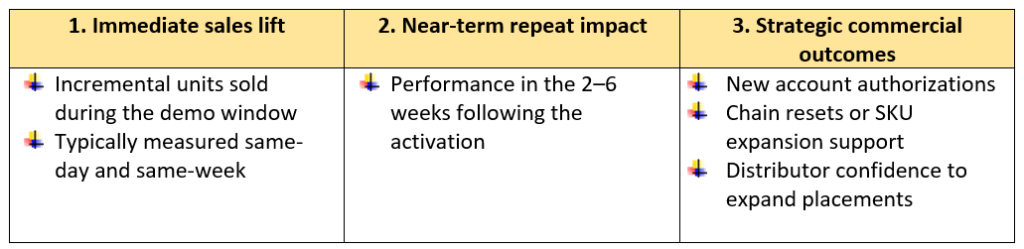
Too many programs only track layer one. High-performing programs consistently connect all three.
Industry baseline assumptions (estimates)
The following ranges reflect aggregated field performance observed across national and regional sampling programs in the U.S. market. These are industry estimates, not guarantees.
- Average fully loaded demo cost (labor, product, logistics, reporting):
$140–$220 per activation - Typical sampling reach per event:
45–90 consumers - Average conversion to purchase during the event:
18%–35%
These benchmarks vary widely based on category, location, staffing quality, and account type.
ROI benchmarks by category
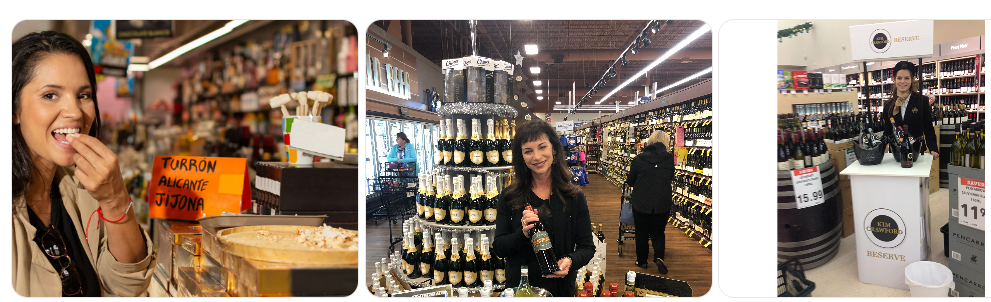
Typical performance range
- On-site purchase conversion: 20%–30%
- Incremental units sold per demo: 12–30 bottles
- Estimated short-term ROI: 1.5x–2.5x
Wine performs consistently well when education is part of the experience.
Why wine converts reliably
- Lower perceived purchase risk
- Flavor discovery drives immediate trial
- Brand story and origin meaningfully influence close rates
Example (generic)
A $180 demo produces 22 incremental bottles at $16 retail. At an estimated supplier margin of $5–$6 per unit, same-day margin recovers roughly 60–70% of the event cost. The remainder is typically recovered through post-event reorder activity and improved shelf stability.
ROI benchmarks for beverage demos in spirits programs
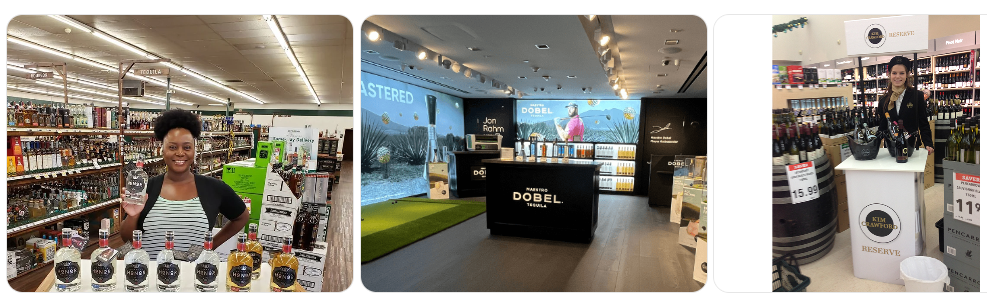
Typical performance range
- On-site purchase conversion: 15%–25%
- Incremental units sold per demo: 8–18 bottles
- Estimated short-term ROI: 1.2x–2.0x
Spirits often underperform in same-day sales but outperform in delayed lift.
Why spirits ROI behaves differently
- Higher price points extend decision cycles
- Cocktail usage occasions drive deferred purchases
- Consumer education materially improves repeat rates
Example (generic)
A premium tequila demo sells only 10 bottles during the event. However, store-level velocity in the following four weeks rises 25%–40% versus baseline (estimate), driven by improved awareness and display compliance.
This is why executive teams should evaluate spirits activations through multi-week ROI benchmarks for beverage demos, not same-day transactions.
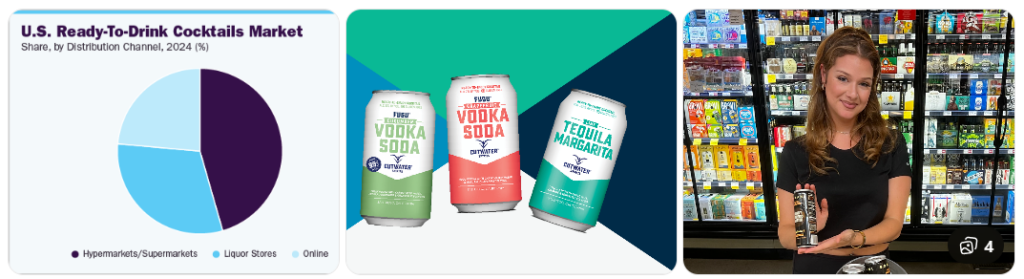
ROI benchmarks for beverage demos in RTD and canned cocktail programs
Typical performance range
- On-site purchase conversion: 25%–40%
- Incremental units sold per demo: 18–40 units
- Estimated short-term ROI: 2.0x–3.5x
RTDs consistently outperform most traditional segments.
Why RTDs lead current ROI benchmarks
- Lower commitment per purchase
- Flavor-led curiosity
- Clear convenience and social usage occasions
What separates average programs from top-tier ROI benchmarks for beverage demos?
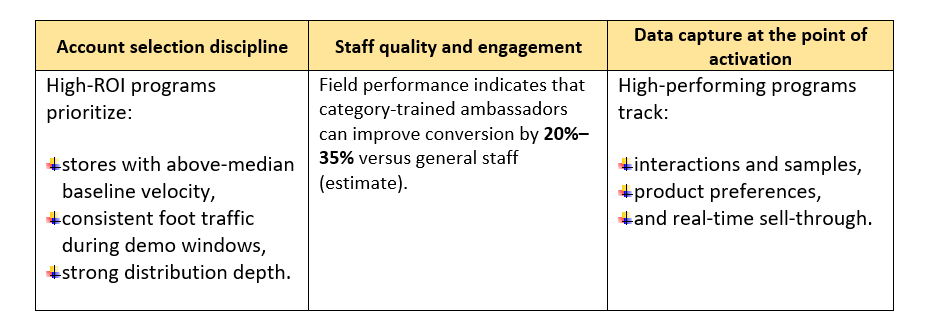
Liquid to Lips operates as a data-first sampling platform, allowing suppliers and distributors to compare activation performance across markets rather than relying on isolated recap reports. As a technology-enabled activation partner and national execution partner, Liquid to Lips helps turn field programs into usable commercial intelligence—without overselling or inflating performance claims.
ROI benchmarks for beverage demos in THC beverage activations
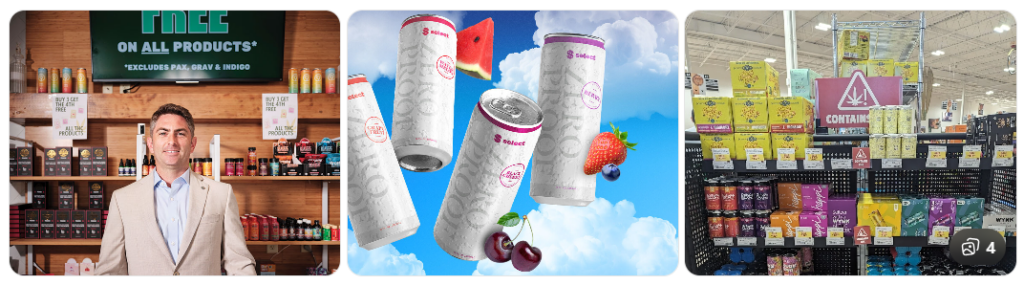
In compliant retail environments, early category data suggests:
- engagement rates: 40%–60%
- on-site purchase conversion: 12%–25% (estimate)
For THC beverages, demos currently deliver more value in:
- consumer education,
- buyer confidence,
- and assortment qualification than immediate revenue.
How to measure real incremental lift for ROI benchmarks for beverage demos?
Why same-day sales is not enough
True incremental lift requires:
- pre-demo velocity baselines,
- post-event performance comparisons,
- adjustments for price or feature activity.
Liquid to Lips supports this model by connecting activation reporting with post-event performance reads, allowing leadership teams to assess net new demand, not just transactional volume.
Practical ROI targets by program objective
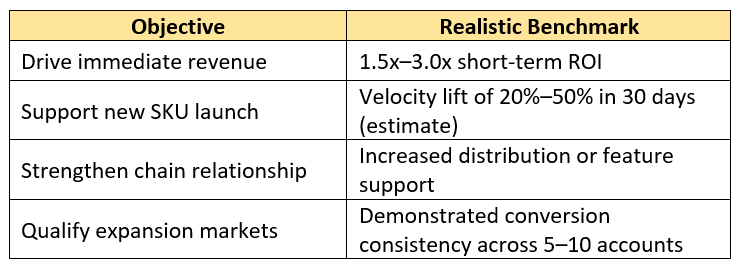
Programs should be designed differently depending on which objective is primary.
Actionable takeaways
- Define the commercial goal before activating.
- Apply category-specific ROI benchmarks for beverage demos.
- Read performance for at least 2–4 weeks post-event.
- Invest in activation reporting and analytics.
- Treat demos as structured sales intelligence—not just marketing activity.
Conclusion: Demos only create ROI when data drives decisions
Sampling remains one of the most effective trial drivers in wine, spirits, RTDs, and emerging THC beverages. But modern programs only succeed when ROI benchmarks for beverage demos are clearly defined, measured consistently, and used to guide future deployment.
Organizations that treat activations as data-driven commercial tools—rather than isolated marketing events—will build stronger distributor relationships, smarter rollout strategies, and more sustainable growth.