Executive Summary
The first 90 days of a beverage launch are decisive—this is where brands either gain traction or fade into distributor portfolios. Success is not driven by awareness alone, but by structured, data-backed activation that converts trial into repeat purchase. High-performing brands align distributor strategy, retail execution, and consumer sampling within a tight feedback loop. This article outlines a practical framework to build measurable momentum in the critical first three months.
Why the First 90 Days Matter More Than the Next 9 Months
In today’s beverage landscape, shelf space is finite and attention is fragmented. Distributors evaluate performance quickly, and underperforming SKUs risk deprioritization within weeks—not quarters.
Industry context (estimates):
- ~60–70% of new beverage SKUs fail to meet velocity expectations within the first 6 months
- Distributors typically reassess new product performance within 30–90 days
- Products with structured sampling programs see 2–3x higher initial velocity compared to those without
The implication is clear: launch is not a moment—it’s a compressed execution window where every activation must drive measurable outcomes.
The 90-Day Momentum Framework
Building momentum requires disciplined sequencing. The most effective launches follow three distinct phases:
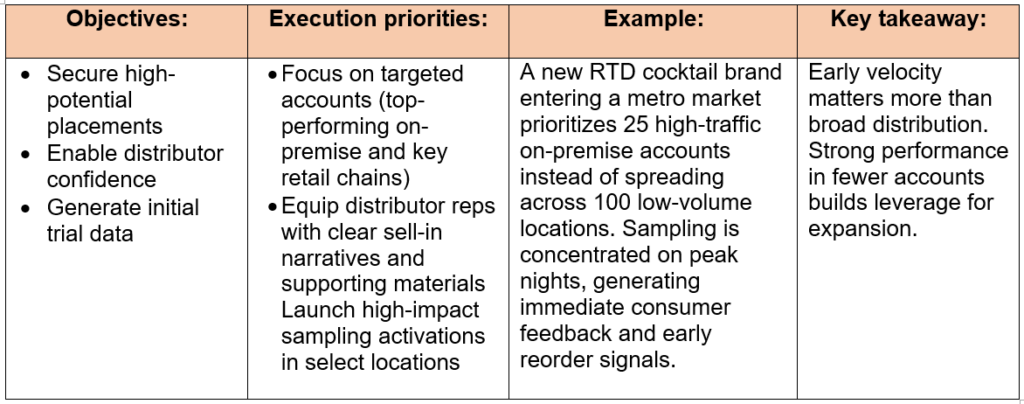
Phase 1 (Days 1–30): Controlled Market Entry
This phase is about precision—not scale.
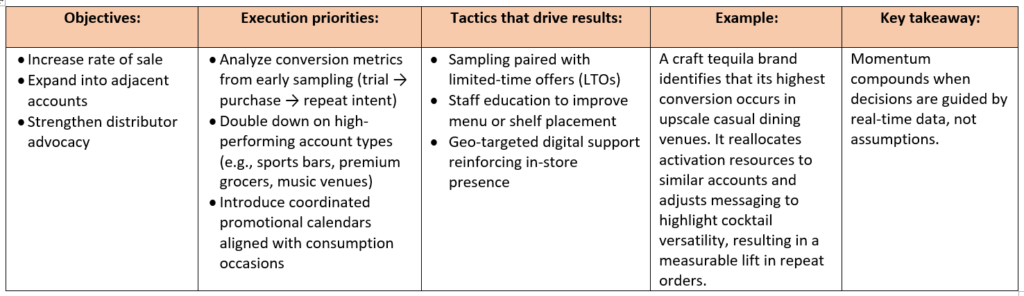
Phase 2 (Days 31–60): Demand Amplification
With initial data in place, the focus shifts to scaling what works.
Phase 3 (Days 61–90): Scale and Sustain
This phase determines whether a product becomes a priority—or an afterthought.
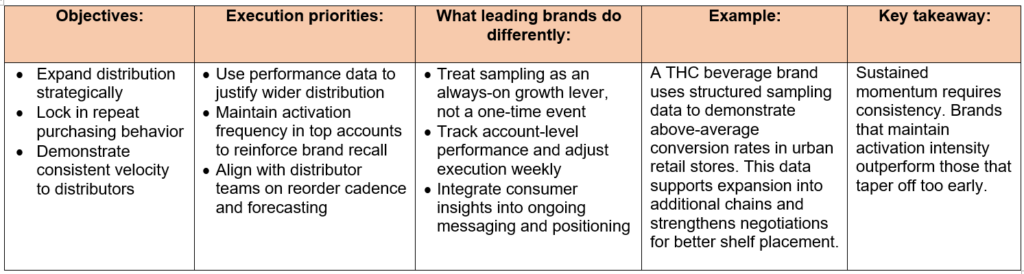
The Role of Data in Driving Launch Success
Execution alone is not enough—measurement is what transforms activity into strategy.
What to Measure in the First 90 Days
At a minimum, brands should track:
- Sampling-to-purchase conversion rate
- Units sold per account per week (velocity)
- Repeat purchase indicators
- Account-level performance variance
- Cost per acquisition (CPA) from activations
Without these metrics, brands risk making decisions based on anecdotal feedback rather than actionable insights.
Closing the Feedback Loop
High-performing brands operate on tight feedback cycles:
- Activate (sampling, promotions, placements)
- Measure (conversion, velocity, engagement)
- Optimize (refine targeting, messaging, execution)
This loop should run continuously throughout the 90-day window.
Estimated impact:
Brands that actively optimize campaigns based on real-time data can improve conversion rates by 20–40% compared to static execution models.
Sampling as a Strategic Growth Engine
Sampling is often misunderstood as a brand awareness tactic. In reality, it is one of the most effective tools for driving immediate sales and validating product-market fit.
Why Sampling Works
- Reduces purchase hesitation, especially for new categories (e.g., THC beverages)
- Creates direct consumer engagement and feedback
- Drives impulse purchases when executed at point-of-sale
Key insight:
Not all sampling is equal. Execution quality, timing, and data capture determine effectiveness.
What Modern Sampling Should Look Like
Leading brands are shifting toward technology-enabled sampling platforms that provide:
- Real-time performance tracking
- Standardized execution across markets
- Scalable national coverage
- Actionable insights at the account level
This approach transforms sampling from a cost center into a measurable revenue driver.
Aligning Distributor Strategy with Market Execution
Distributor support is critical—but it must be earned through performance.
How to Build Distributor Confidence
- Share clear launch plans with defined KPIs
- Provide early performance data demonstrating traction
- Align on target accounts and execution priorities
Distributors are more likely to prioritize brands that show disciplined execution and consistent results.
Common Pitfalls to Avoid
- Overextending distribution too early
- Running disconnected or one-off activations
- Failing to track and communicate performance metrics
- Relying solely on brand awareness without driving trial
These missteps often lead to stalled momentum and reduced distributor engagement.
Actionable Takeaways for Beverage Leaders
To maximize the first 90 days of a launch:
- Start focused: Prioritize high-impact accounts over broad distribution
- Invest in sampling: Treat it as a core sales driver, not a support tactic
- Measure everything: Build decisions around data, not assumptions
- Optimize continuously: Adjust execution weekly based on performance
- Align stakeholders: Ensure brand, distributor, and retail partners are working toward shared KPIs
Conclusion: Momentum Is Built, Not Assumed
The difference between a successful launch and a stalled product is rarely the product itself—it’s the execution strategy behind it. In the first 90 days, brands must operate with precision, discipline, and a commitment to data-driven decision-making.
Technology-enabled activation partners—those that combine national execution capabilities with real-time performance insights—are increasingly central to this process. By integrating structured sampling, measurable outcomes, and continuous optimization, brands can turn early trial into sustained growth.
In a market where speed and performance define success, momentum is not left to chance—it is built, measured, and scaled.