Executive Summary
Sampling to de-risk new SKUs is one of the most effective strategies beverage brands can use to validate demand before scaling. In a highly competitive spirits, wine, beer, and THC beverage landscape, relying on assumptions can lead to costly missteps. By using structured, data-driven sampling programs, brands can gather real consumer insights, improve conversion rates, and make informed go-to-market decisions. When executed correctly, sampling to de-risk new SKUs becomes a measurable growth driver rather than a promotional expense.
Why New SKUs Fail—and How Sampling Reduces Risk
The Reality of SKU Launch Risk
New product launches in beverage alcohol and emerging THC categories face significant challenges:
- Limited shelf space and distributor attention
- Unproven consumer demand
- High cost of awareness-building
- Inconsistent retail execution
Estimated benchmark: Up to 60–70% of new SKUs underperform within the first 6 months due to weak trial and poor market fit (industry estimate).
Sampling as a Risk Mitigation Tool
Sampling directly addresses the core failure points:
- Converts awareness into immediate product trial
- Generates real-time consumer feedback
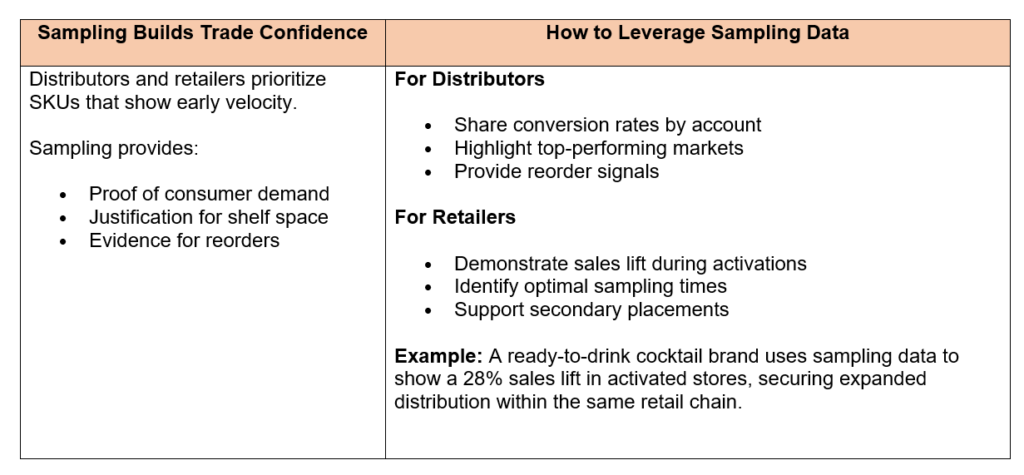
- Supports distributor and retailer confidence
- Creates measurable demand signals
Instead of relying on assumptions, brands can use sampling to test, learn, and optimize before scaling.
The Strategic Role of Sampling in SKU Validation
Sampling Is More Than Trial—It’s Market Intelligence
High-performing brands treat sampling as a data collection engine, not just a promotional tactic.
What Sampling Can Validate

Estimated impact: Brands using structured sampling insights are 2x more likely to adjust successfully pre-scale, improving long-term SKU performance (industry estimate).
Designing High-Impact Sampling Programs
Precision Over Volume
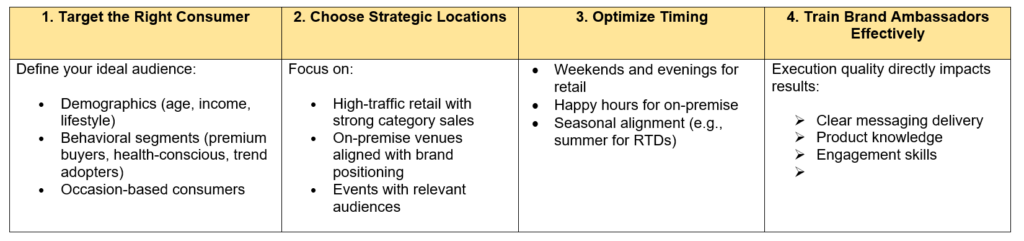
Mass sampling without targeting leads to wasted spend. Effective programs prioritize who, where, and when.
Key Design Principles
Capturing Data: Turning Sampling into a Decision Engine
The Difference Between Activity and Insight
Sampling without data capture is a missed opportunity. The most effective programs integrate real-time data collection.
What to Capture
- Consumer demographics
- Taste feedback (ratings, preferences)
- Purchase intent
- Immediate conversion (on-site purchase)
- Location and time performance
Key Metrics That Matter
- Trial-to-purchase conversion rate
- Cost per sample vs. cost per acquisition
- Sales lift per activation
- Repeat purchase indicators
Estimated benchmark: Well-executed sampling programs achieve 20–35% conversion rates, with higher performance in premium and RTD categories (industry estimate).
Technology as a Multiplier
Technology-enabled platforms allow brands to:
- Track performance in real time
- Compare markets and accounts
- Optimize spend dynamically
This is where a data-first sampling platform becomes critical—transforming field activity into actionable insight.
Aligning Sampling with Distributor and Retail Strategy
Scaling with Confidence: From Test to Expansion
When to Scale a New SKU
Scaling decisions should be based on:
- Consistent conversion rates
- Positive consumer feedback trends
- Strong account-level performance
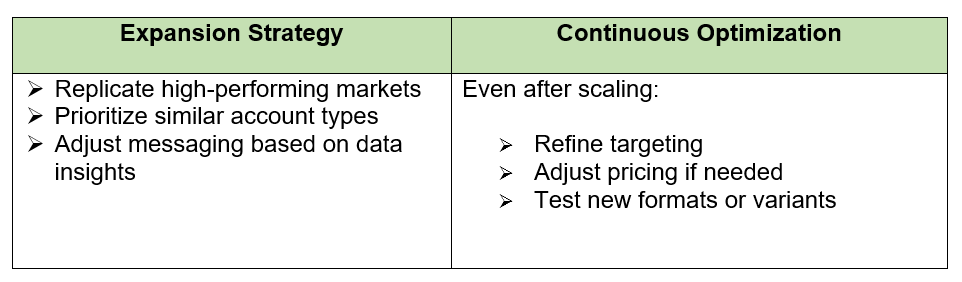
Brands that treat sampling as an ongoing process—not a one-time event—build stronger, more resilient SKU performance.
Common Mistakes to Avoid
- Sampling without clear objectives → leads to unfocused execution
- No data capture → eliminates learning opportunities
- Over-sampling low-value locations → inefficient spend
- Ignoring post-sampling follow-up → missed repeat purchase potential
- Disconnect between sampling and sales teams → weak execution
Actionable Takeaways
- Use sampling early to validate demand before scaling production
- Treat sampling as a data collection tool, not just a marketing tactic
- Focus on targeted, high-quality execution over volume
- Align sampling insights with distributor and retail strategies
- Invest in technology-enabled platforms for real-time optimization
Conclusion: Sampling as a Strategic Growth Lever
In a competitive and crowded beverage landscape, launching a new SKU without validated demand is a costly risk. Sampling provides a direct, measurable way to reduce that risk—turning consumer interaction into actionable insight.
Brands that adopt data-driven sampling strategies gain a clear advantage: faster learning cycles, stronger trade relationships, and more confident scaling decisions. With the right combination of national execution, real-time data capture, and strategic alignment, sampling evolves from a tactical expense into a core growth engine.
A technology-enabled, national activation partner like Liquid to Lips supports this evolution—connecting field execution with the data needed to make smarter, faster decisions at every stage of SKU development.