Best practices for sampling in Kroger, H-E-B, and Total Wine require more than well-trained brand ambassadors and product availability. They demand retailer-specific execution models, disciplined data capture, and operational alignment with distributor and retail partners. For beverage brand leaders, supplier sales teams, and beverage directors, sampling has become a commercial tool—not a marketing expense.
This guide outlines how to structure high-performing sampling programs across three of the most influential beverage retailers in the U.S.: Kroger, H-E-B, and Total Wine & More.
Executive Summary
Best practices for sampling in Kroger, H-E-B, and Total Wine center on aligning execution to each retailer’s shopper mission, operating standards, and category role. Programs that integrate store-level data, disciplined compliance controls, and distributor coordination consistently outperform promotional-only activations. When sampling is built as a data stream—not just an experience—it becomes a scalable growth lever.
Why Retail Beverage Sampling Still Drives Measurable Growth
Despite rapid growth in e-commerce and digital advertising, physical trial remains a decisive conversion driver for beverage.
Across beverage categories, trial remains one of the strongest predictors of first-time purchase.
Industry estimates (trade survey averages):
- Approximately 65–75% of new beverage trials still occur in physical retail.
- Roughly 30–40% of first-time purchasers cite in-store discovery or staff guidance as a primary influence.
For brands operating nationally, the strategic question is not whether sampling works—but how to apply best practices for sampling in Kroger, H-E-B, and Total Wine to consistently generate measurable lift.
Best Practices for Sampling in Kroger
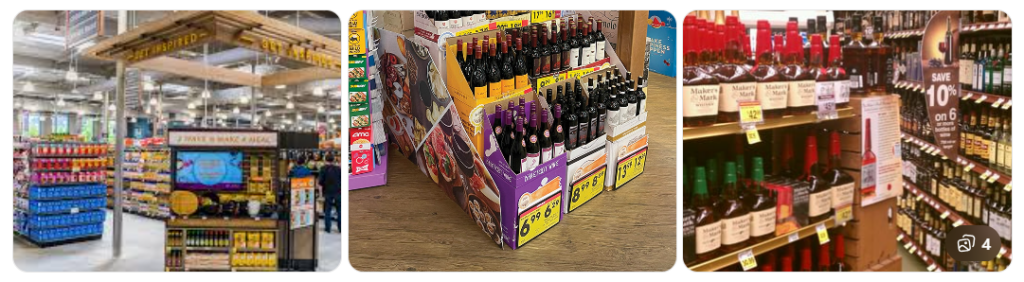
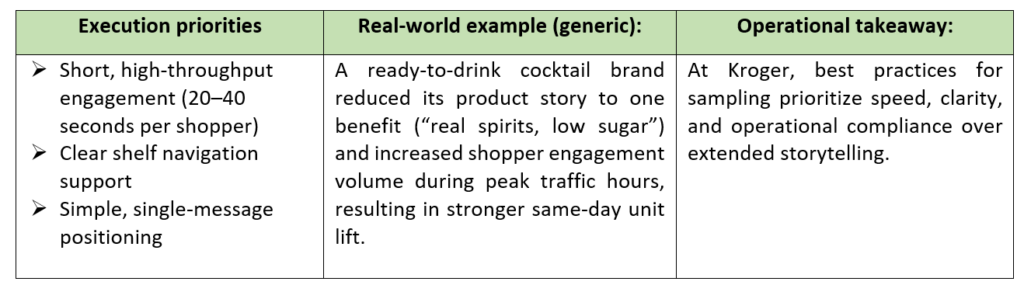
Kroger’s model is built around scale, consistency, and traffic efficiency. Sampling must fit into a tightly managed operating environment.
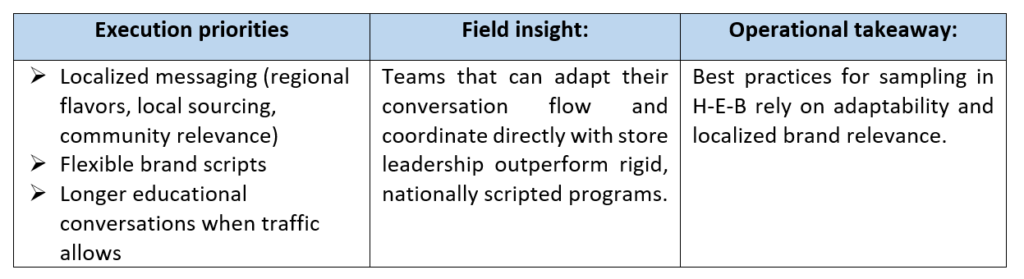
Best Practices for Sampling in H-E-B
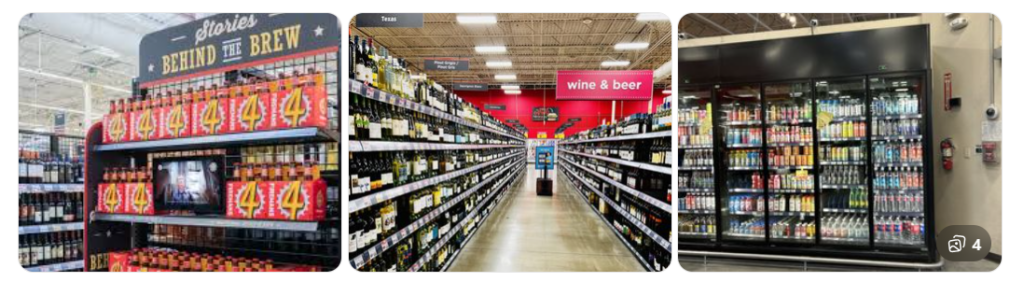
H-E-B operates with a strong local and community-driven culture. Store leadership influence is higher, and shopper engagement expectations differ from national chains.
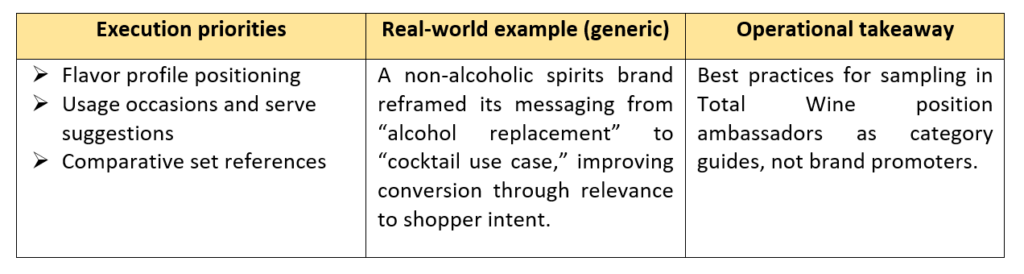
Best Practices for Sampling in Total Wine
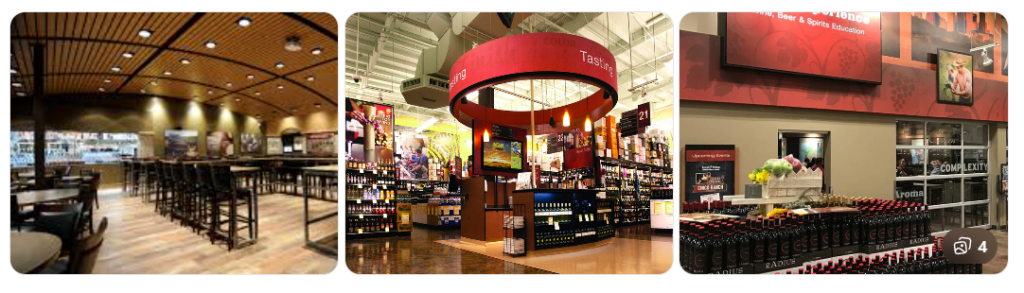
Total Wine shoppers are highly research-driven and category curious. Sampling programs perform best when they mirror the retailer’s education-led selling culture.
Sampling Teams Must Be Built for Retail Environments
Retail activation requires a fundamentally different operating skill set than experiential or event marketing.
High-performing teams demonstrate:
- Ability to engage without disrupting store traffic
- Accurate shelf location awareness
- Collaboration with store associates
- Compliance knowledge for regulated categories
When staffing models fail to match retail operating realities, even strong brand messaging underperforms.
Use Data to Select Stores, Not Just Available Calendars
Sampling schedules should be driven by performance indicators, not convenience.
High-impact store selection incorporates:
- historical velocity
- recent distribution changes
- category shelf presence
- local promotional activity
Industry estimate:
Programs that prioritize high-performing and growth-trajectory stores typically generate 15–25% higher unit lift than random store selection.
This is a foundational element of modern best practices for sampling in Kroger, H-E-B, and Total Wine.
Capture More Than Samples Poured
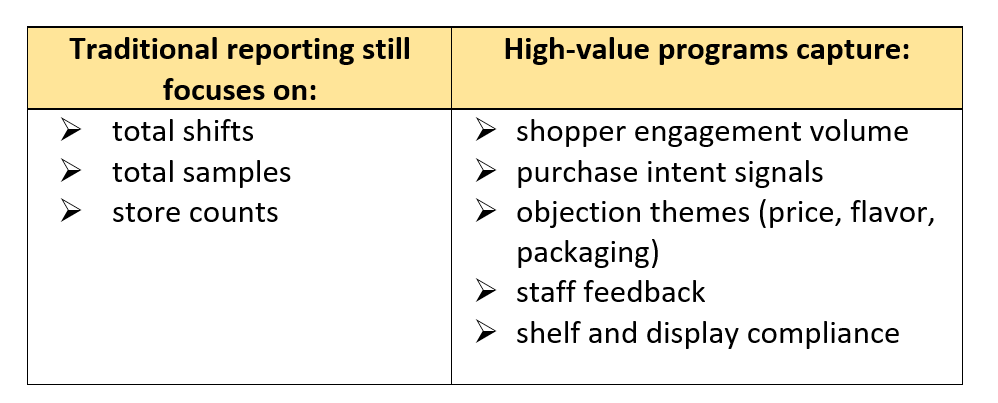
This transforms sampling into a structured insight engine for brand, sales, and category teams.
Compliance and Control Are Now Retail Expectations
Retailers increasingly require:
- digital shift verification
- standardized reporting
- documented training completion
This is especially critical for alcohol and emerging THC beverage programs. Technology-enabled compliance protects brand reputation and retailer relationships while improving execution consistency.
Distributor Alignment Improves Activation ROI
Sampling is most effective when distributor teams are integrated into the activation strategy.
High-performing programs:
- share activation calendars in advance
- flag priority stores for follow-up
- circulate post-activation insights to sales leadership
Sampling becomes a commercial support tool—not a parallel marketing initiative.
Technology-Enabled Activation as an Industry Standard
As a technology-enabled activation partner and data-first sampling platform, Liquid to Lips Marketing supports beverage brands through:
- real-time field reporting
- standardized compliance tracking
- centralized team management
- performance analytics across markets
The strategic advantage is not volume of activations—it is market-level insight that informs sales strategy, retail execution, and future product positioning.
Actionable Takeaways
To implement best practices for sampling in Kroger, H-E-B, and Total Wine:
- Design retailer-specific engagement models.
- Train teams for retail operations—not events.
- Prioritize data-driven store and day selection.
- Capture behavioral and qualitative insights.
- Integrate distributor sales teams into planning.
- Deploy technology for real-time visibility and compliance.
Conclusion: Sampling Must Become a Source of Intelligence
Best practices for sampling in Kroger, H-E-B, and Total Wine require a shift from promotional thinking to commercial execution strategy. Brands that treat sampling as a structured data and insight platform—not just an activation—gain a measurable advantage in retail performance, distributor collaboration, and scalable growth.