
Executive Summary
In beverage sampling, the industry has traditionally optimized for cost per sample. But that metric alone no longer reflects how consumers actually engage with brands—or how activations drive measurable commercial impact. A more accurate and decision-ready KPI is cost per sip: the true cost of delivering a meaningful product experience. For brands competing in crowded spirits, wine, beer, and emerging THC beverage categories, cost per sip provides a clearer view of trial quality, engagement depth, and activation ROI.
The Problem with Cost Per Sample

Cost per sample is simple:
Total program cost ÷ number of samples distributed
It is easy to report, easy to benchmark, and easy to optimize for on a spreadsheet.
But it answers only one operational question:
How cheaply can I put a product in someone’s hand?
It does not answer the strategic questions brand leaders care about:
- Did consumers actually experience the product?
- Did they consume enough to understand flavor, format, or functionality?
- Did the interaction drive purchase intent, brand recall, or follow-up behavior?
In an environment where:
- shelf space is tighter,
- distributor expectations are higher, and
- emerging brands are competing against scaled incumbents,
counting samples is no longer enough.
Introducing Cost Per Sip
Cost per sip measures the true cost of a meaningful consumption experience:
Total activation investment ÷ total verified sips consumed
While not every program literally tracks individual sips, the concept focuses on actual product engagement, not simple distribution.
In practical terms, cost per sip incorporates:
- portion size and product format
- real consumption behavior
- staff execution quality
- sampling flow and dwell time
- consumer interaction depth
It reframes sampling from logistics to experience economics.

Why Engagement Quality Now Matters More Than Volume

The beverage landscape has fundamentally shifted.
Category fragmentation is accelerating
Industry estimate: U.S. beverage alcohol and functional beverage shelves now carry 25–40% more SKUs than a decade ago, driven by:
- RTDs
- better-for-you formats
- low/no alcohol
- functional and THC beverages
More options mean:
- faster decision cycles at shelf
- less tolerance for vague trial experiences
- more pressure on brands to clearly communicate differentiation
A rushed, under-poured or poorly explained sample does not compete.
Consumers evaluate faster—but more critically
Industry estimate: over 60% of shoppers who try a new beverage make a purchase decision within the same visit or within 48 hours.
But that decision is increasingly based on:
- flavor clarity
- mouthfeel
- functional effect
- brand story
- usage occasion understanding
All of those require real consumption time and interaction, not a quick handoff.
Cost per sip captures whether you actually delivered that experience.

Cost Per Sip Beverage Sampling vs. Cost Per Sample: A Practical Comparison
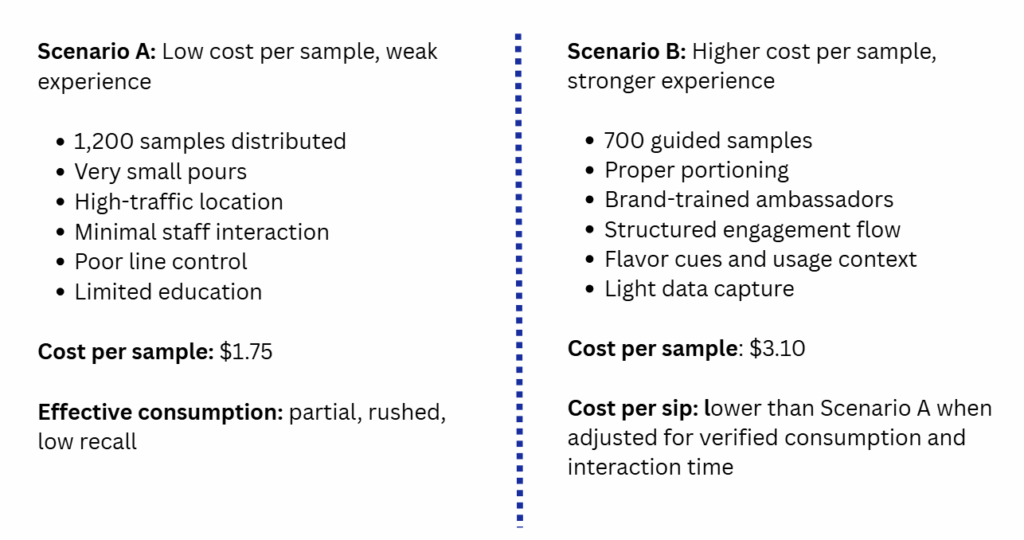
In Scenario B, fewer samples produce:
- higher product understanding
- better brand recall
- more credible sales conversations with retail and distributor partners
From a business standpoint, Scenario B often produces a lower cost per qualified trial.
Cost Per Sip Aligns Better With Commercial Outcomes

For supplier sales leaders and distributor executives, the real question is:
Which activations help move product after the event?
Cost per sip correlates more closely with downstream impact because it reflects:
1. Real product evaluation
Consumers need enough exposure to:
- register flavor complexity
- assess balance and finish
- understand functional benefit (especially in THC and wellness beverages)
Tiny or rushed samples undercut that.
2. Education delivery
Guided sips allow ambassadors to deliver:
- usage occasions
- competitive positioning
- price tier justification
- on-premise or off-premise placement logic
Those conversations do not happen when teams are optimized only for throughput.
3. Data Credibility
When programs are designed around engagement rather than volume, brands can more reliably capture:
- intent to purchase
- brand awareness shifts
- product feedback
- post-event actions
Cost per sip encourages programs that can actually support reporting to:
- senior leadership
- distributor partners
- internal sales teams

Why Cost Per Sip Is Especially Critical for Emerging Brands
Emerging founders often feel pressure to “get liquid in as many hands as possible.”
That instinct is understandable—but risky.
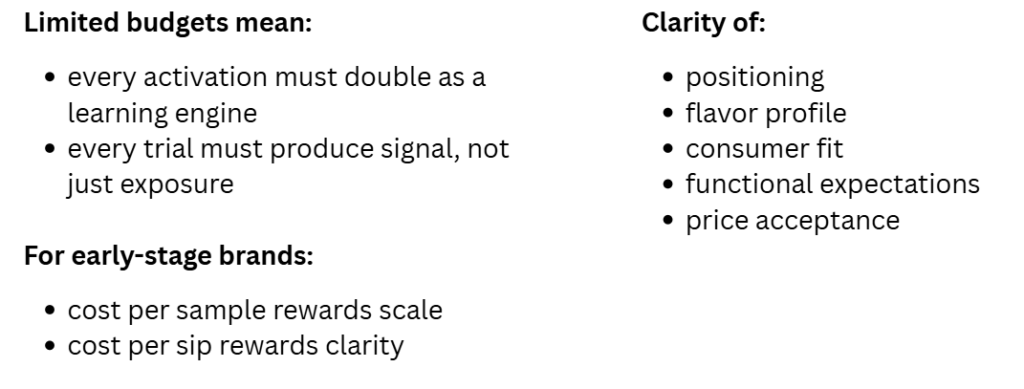
In practice, emerging brands that optimize for cost per sip learn faster and waste less inventory and labor on unproductive trial.
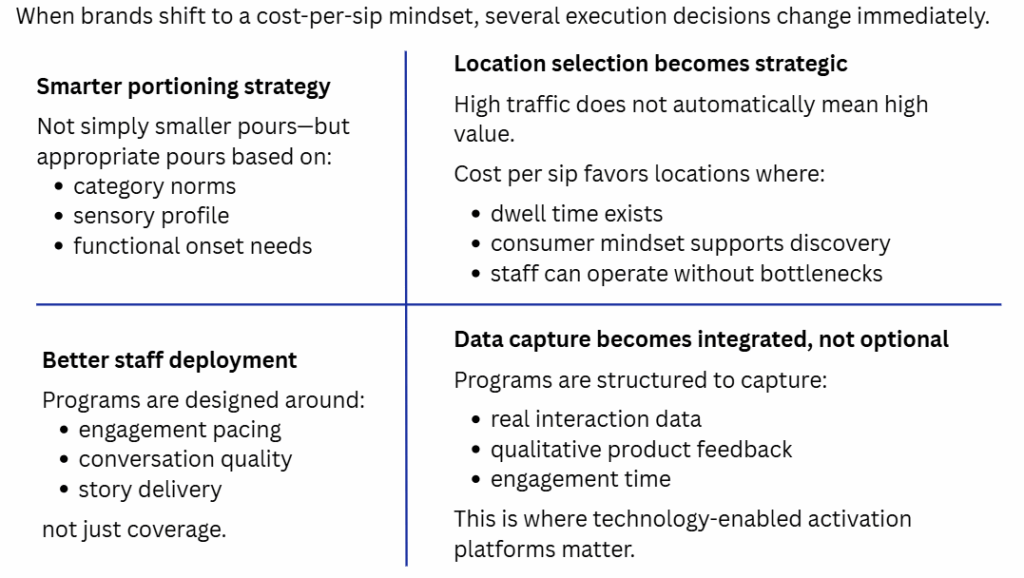
How Cost Per Sip Changes Activation Design
The Role of Technology in Measuring Real Engagement

Tracking cost per sip does not require intrusive measurement.
It requires:
- structured engagement workflows
- digital activation tools
- standardized ambassador execution
- real-time reporting infrastructure
A modern, data-first sampling platform allows brands to move beyond:
- anecdotal recaps
- manual tallies
- delayed reporting
and toward:
- verified interactions
- consistent metrics
- scalable national insights
This is increasingly important for national brands executing across:
- multiple retailers
- multiple distributors
- multiple regulatory environments
Liquid to Lips was built to support this shift—operating as a technology-enabled activation partner that designs programs around engagement quality, data integrity, and national execution consistency.
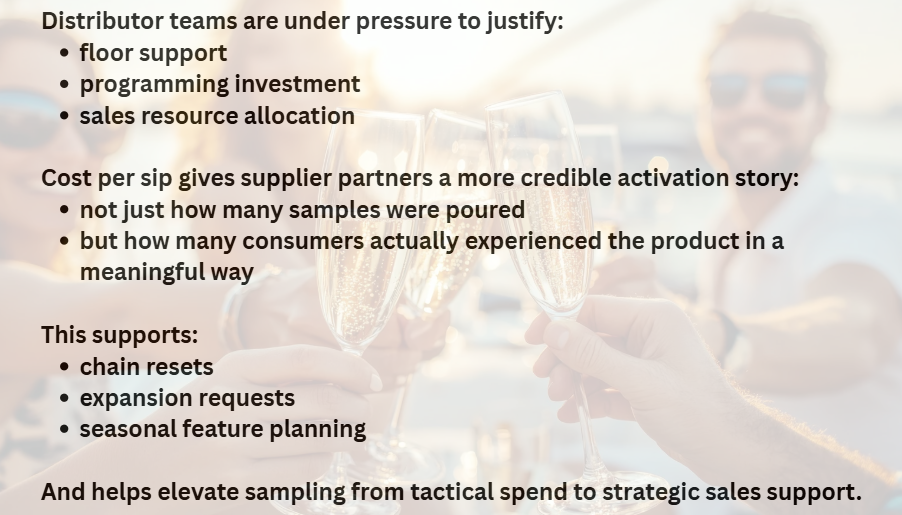
How Cost Per Sip Supports Distributor and Retail Conversations
Actionable Takeaways for Brand and Sales Leaders

If you want to begin shifting your organization toward cost-per-sip thinking, start with the following:
1. Redefine success metrics
- Track engagement time per consumer
- Track guided vs. unguided interactions
- Separate “samples distributed” from “experiences delivered”
2. Audit portion strategy
- Does the sample size allow real evaluation?
- Does it match your category and brand promise?
3. Evaluate staff training and scripting
- Can ambassadors clearly articulate:
- flavor differentiation
- usage occasions
- competitive positioning?
4. Demand engagement-level reporting
- Not just event counts and hours
- But interaction data and feedback
5. Pilot cost-per-sip modeling on one market
Measure learning, not just reach
Compare results to a traditional high-volume sampling program
Conclusion: Sampling Is No Longer About Distribution—It’s About Experience Economics
In today’s beverage market, the limiting factor is not how many samples you can pour.
It is how effectively you can create:
- real product understanding
- credible brand memory
- actionable data for your sales organization
Cost per sip reframes activations around what actually drives commercial value: meaningful consumption and engagement.
As a national execution partner and data-first sampling platform, Liquid to Lips helps beverage brands design programs that optimize for experience quality, measurable engagement, and scalable insights—so every sip works harder than every sample ever could.