
Executive Summary
In-store alcohol sampling remains one of the most effective tools for driving trial—but too often, brands measure success using incomplete metrics like bottles poured or short-term lift. To calculate the true return on investment (ROI) of sampling, beverage leaders must connect activation activity to distribution goals, shopper behavior, and long-term brand performance. This article outlines a practical, data-driven framework for evaluating in-store sampling as a revenue and growth channel—not just a promotional expense.
Why Most Sampling ROI Calculations Fall Short
For decades, the industry has evaluated in-store sampling through a narrow operational lens:
- Number of events executed
- Bottles opened
- Samples poured
- Same-day unit lift
While these metrics are operationally useful, they fail to answer the question senior leaders actually care about:
Did sampling materially contribute to revenue growth, distribution strength, or brand velocity?
In an environment where:
- distributor resources are constrained,
- retail resets are more competitive, and
- emerging brands are fighting for sustainable shelf presence,
sampling must be evaluated as a commercial strategy—not a brand experience tactic.
True ROI starts with redefining what “return” really means.
Defining “True ROI” for In-Store Alcohol Sampling
A practical definition of sampling ROI should include three categories of impact:
1. Immediate Revenue Impact
What happens at the shelf during the activation window?
2. Downstream Performance Impact
What happens to that SKU after the activation ends?
3. Strategic Market Impact
What does sampling unlock with retailers and distributors?
When all three are measured together, sampling becomes a measurable growth lever.
Step 1: Start With Fully Loaded Activation Cost
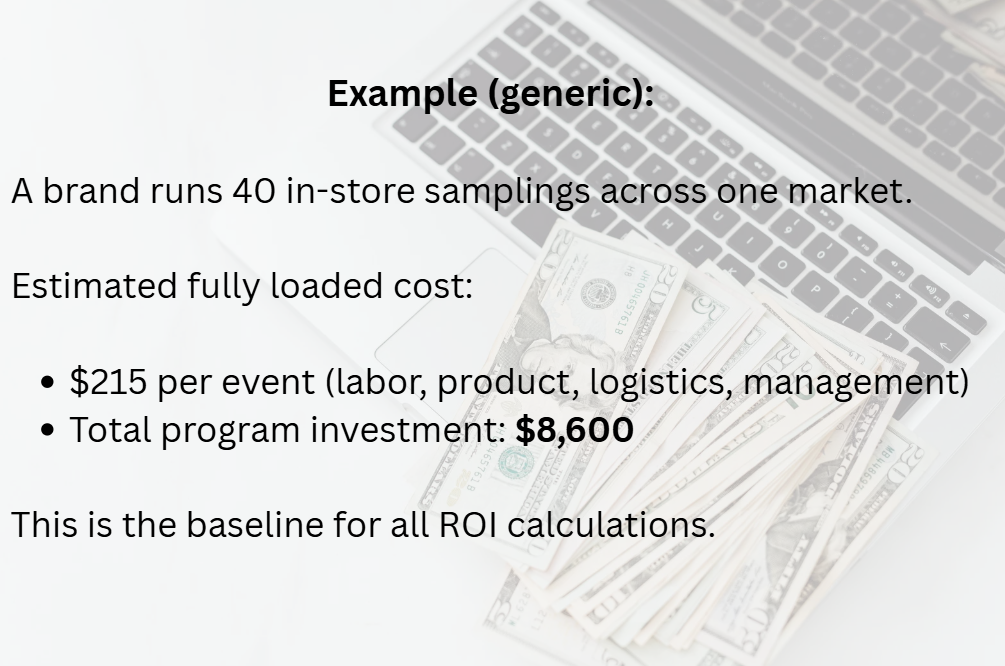
Before evaluating return, brands must calculate true investment.
This typically includes:
- Field staff and brand ambassador labor
- Product cost (including shrink and damage)
- Distributor handling or fulfillment fees
- Logistics and warehousing
- Compliance and permits
- Technology or reporting tools
- Program management and field oversight
Step 2: Measure Same-Day Conversion — But Do It Correctly
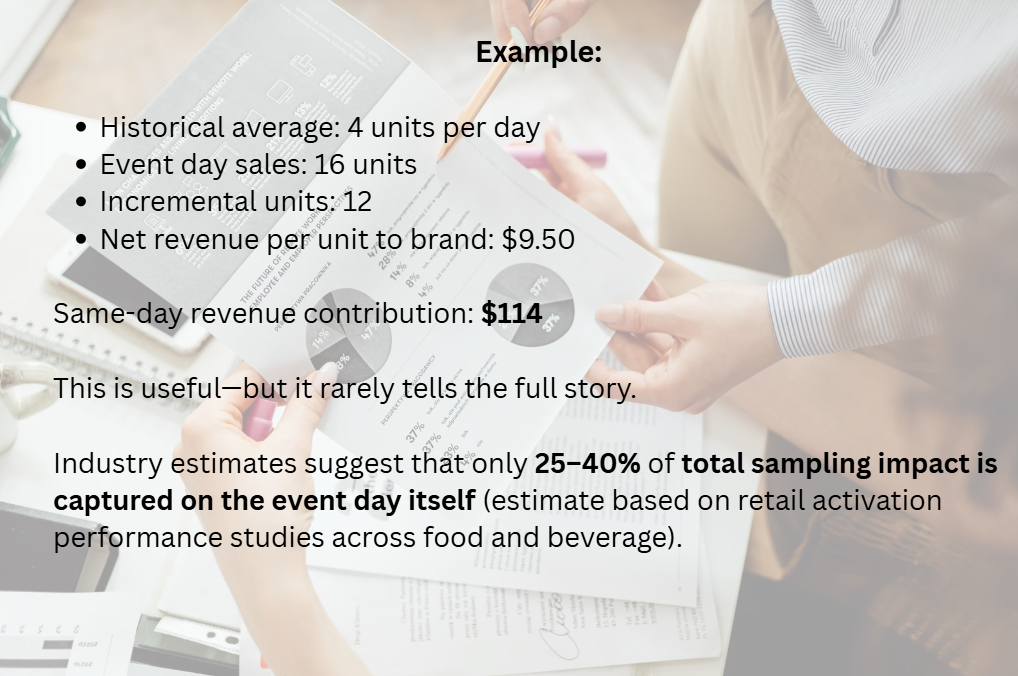
Same-day lift is still important—but it must be normalized.
Instead of only tracking units sold during the event, brands should measure:
- Baseline store velocity for the SKU
- Event-day lift vs. historical average
- Lift across both featured SKUs and halo SKUs
A more accurate same-day formula:
Incremental units sold = Event day units – historical daily average
Same-day revenue contribution = incremental units × net revenue per unit
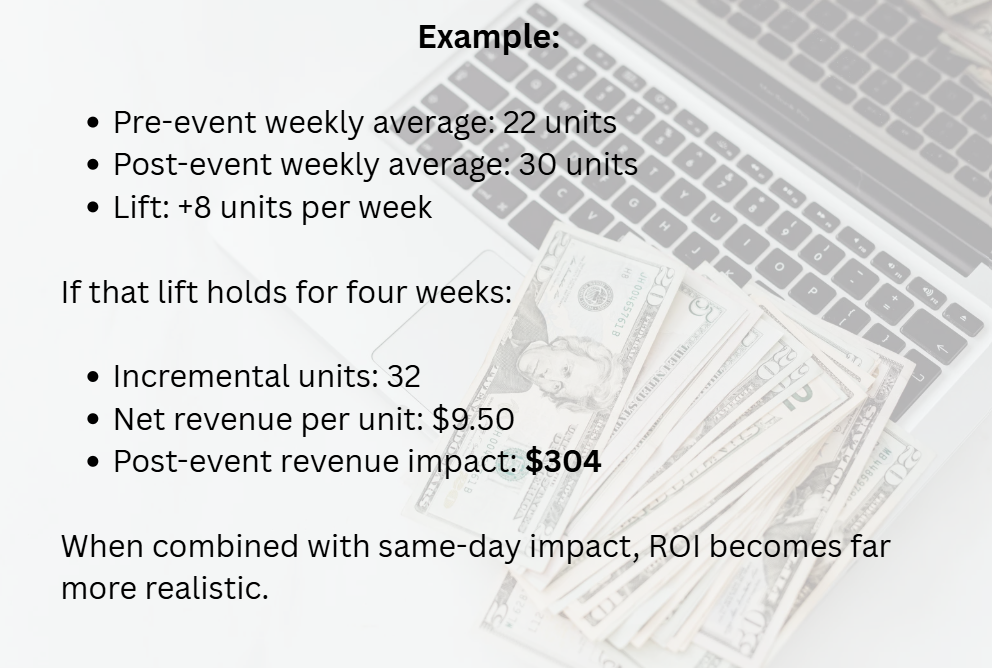
Step 3: Track Post-Event Velocity Lift
This is where most brands under-measure ROI.
A properly executed sampling event often improves:
- rate of sale,
- shopper familiarity,
- repeat purchase likelihood.
To calculate this:
Compare:
- average weekly velocity for 2–4 weeks before the event
- average weekly velocity for 2–4 weeks after the event
Step 4: Include Distribution and Shelf Leverage
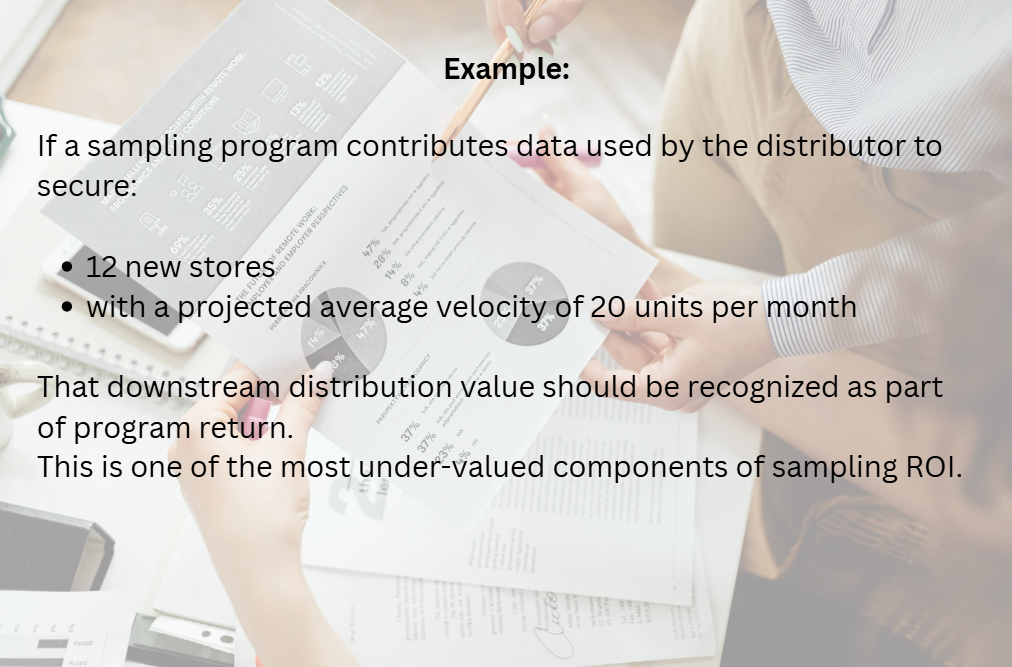
Sampling programs are rarely just about selling through existing shelf.
They are often deployed to:
- support new SKU launches
- protect marginal shelf space
- support chain authorization conversations
- strengthen distributor selling stories
While distribution impact is harder to attribute precisely, it can be modeled conservatively.
Practical proxy metrics include:
- stores that retain placement after activation
- additional facings secured post-program
- new store placements supported by sampling performance data
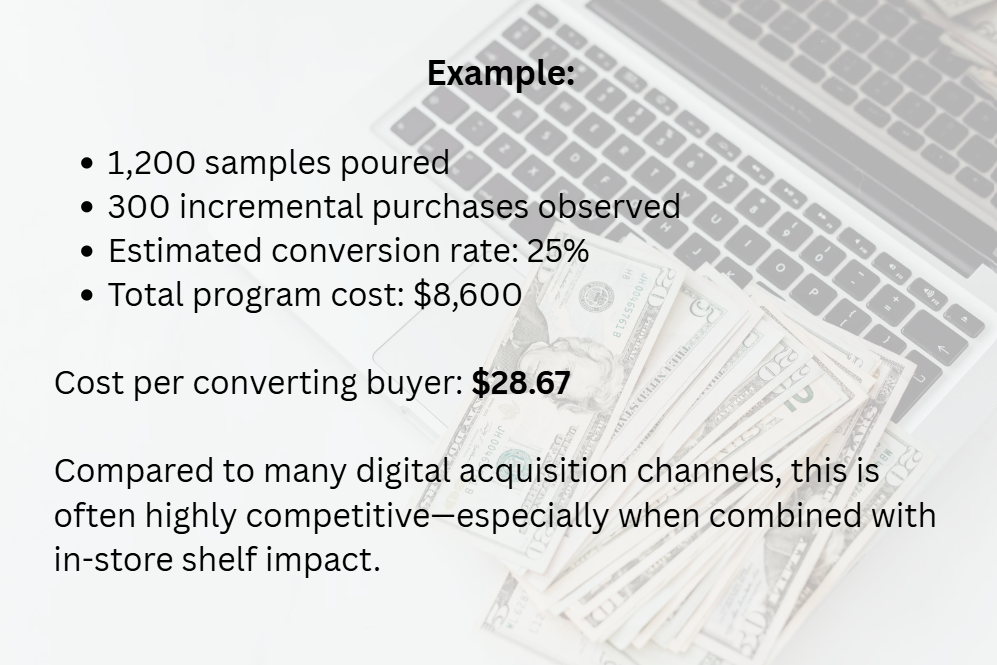
Step 5: Account for Consumer Acquisition Value
Sampling is a customer acquisition channel.
Light industry benchmarks indicate that:
- alcohol sampling conversion rates typically range from 15–35% depending on category and execution quality (estimate).
- of those converters, repeat purchase rates can exceed 30–45% over 60–90 days for high-engagement categories such as RTDs, flavored spirits, and craft beer (estimate).
While few alcohol brands can track individual shoppers due to regulatory and data limitations, brands can still model:
- cost per trial
- estimated cost per converting buyer
Step 6: Calculate a Blended ROI Model

A more realistic sampling ROI model looks like this:
Total Return =
- Same-day incremental revenue
- post-event velocity lift revenue
- modeled distribution revenue contribution
- long-term repeat purchase contribution (conservative estimate)
True ROI (%) =
(Total return – total program cost) ÷ total program cost
Real-world style example:
- Same-day revenue: $4,560
- Post-event lift revenue (4 weeks): $12,160
- Modeled distribution impact (3 months): $9,000
Total return: $25,720
Program cost: $8,600
True ROI: 199%
This level of analysis is what distributor partners and retailer buyers increasingly expect when evaluating activation programs.
Why Execution and Data Infrastructure Matter More Than Ever
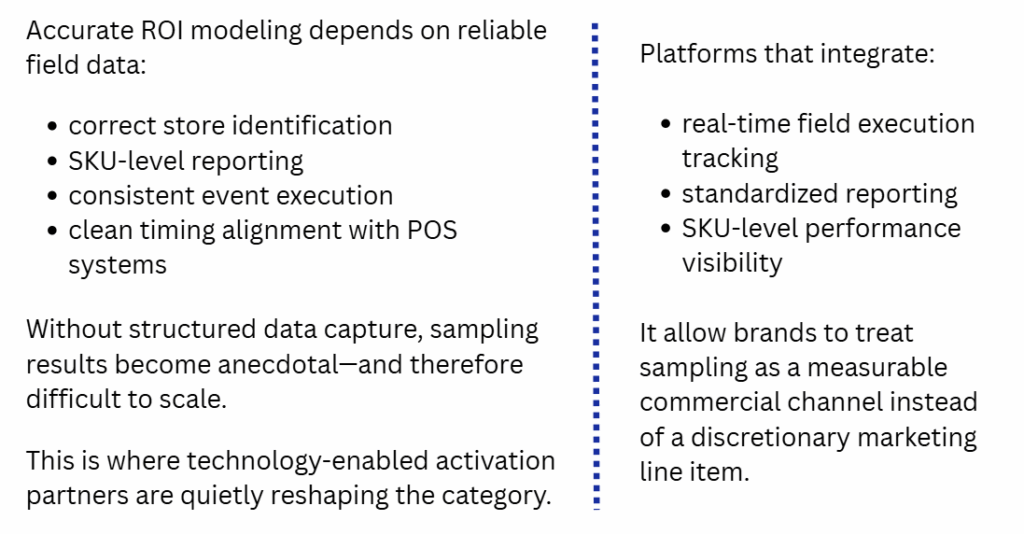
At Liquid to Lips Marketing, sampling programs are designed as data-first activations—connecting national field execution with structured performance reporting so suppliers, distributors, and brand teams can make faster, more defensible decisions.
The goal is not more events. It is better intelligence from every event.
Actionable Takeaways for Beverage Leaders
To calculate—and improve—the true ROI of in-store sampling:
- Shift your primary KPI from “samples poured” to incremental revenue and velocity lift
- Always compare pre- and post-event performance windows
- Track distribution outcomes tied to sampling support
- Build conservative, repeatable ROI models rather than one-off success stories
- Require standardized data collection across all markets
- Treat sampling as a revenue-support channel—not a branding expense
Conclusion: Sampling Is No Longer a Soft Metric Program
In-store alcohol sampling remains one of the few marketing tactics that directly influences both shopper behavior and retail decision-making. But its value is only visible when brands move beyond surface-level metrics and adopt structured ROI frameworks.
Data-driven activations allow beverage leaders to defend budgets, strengthen distributor relationships, and prioritize markets with the highest commercial return.
With national execution capabilities and a technology-enabled, data-first sampling platform, partners such as Liquid to Lips Marketing help brands turn field activity into measurable growth intelligence—so every pour contributes to smarter, more scalable decisions.