
Executive Summary
Beverage activations generate valuable field data insights. By analyzing these insights, beverage brands can convert on-the-ground activations into executive-level strategies that improve distribution, messaging, and growth outcomes.
The Hidden Value of Field Data
Sampling events, retail demos, and on-premise activations are often treated as tactical line items—necessary, but difficult to quantify beyond impressions or cases sold. In reality, these moments are one of the most direct feedback loops available to beverage brands.
Every interaction at the point of trial offers insight into:
- Consumer preferences and objections
- Price sensitivity and purchase intent
- Competitive comparisons
- Regional demand signals
Industry estimate: Brands that systematically capture field data see up to 20–30% improvement in campaign efficiency compared to those relying solely on sales data and distributor feedback.
The challenge is not access to data—it’s structure and translation.
From Activity Metrics to Business Intelligence
What Most Brands Track
Traditional activation reporting tends to focus on:
- Samples distributed
- Bottles sold during the event
- Foot traffic or estimated impressions
While useful, these metrics are descriptive, not diagnostic. They tell you what happened, but not why.
What High-Performing Brands Capture
Leading beverage organizations are evolving their field data strategy to include:
- Conversion rates (samples to purchases)
- Consumer sentiment (taste, packaging, price feedback)
- Account-level performance (which venues drive repeat demand)
- Demographic patterns (age bracket, occasion, preferences)
This shift transforms activations from a cost center into a source of commercial intelligence.
Structuring Data Collection in the Field
Standardization Is the Foundation
Without consistent data inputs, insights become unreliable. The most effective programs implement:
- Mobile reporting tools for real-time data entry
- Standardized survey questions across markets
- Clear definitions for key metrics (e.g., what qualifies as a “conversion”)
For example, a spirits brand running 200+ tastings nationally can compare performance across regions only if each activation captures the same data points in the same format.
Balancing Depth and Practicality
Field teams operate in fast-paced environments. Data collection must be:
- Quick (under 60 seconds per entry where possible)
- Intuitive (minimal training required)
- Relevant (focused on decisions, not vanity metrics)
A well-designed system prioritizes signal over noise.
Turning Field Inputs into Executive-Level Insights
Collecting data is only half the equation. The real value lies in how it informs strategic decisions.
1. Identifying High-Performing Accounts
By aggregating activation data, brands can pinpoint:
- Accounts with the highest conversion rates
- Locations driving repeat purchases post-event
- Venues aligned with target demographics
Example:
A wine brand discovers that upscale casual restaurants outperform nightlife venues by 40% in conversion, leading to a reallocation of sampling budgets.
2. Refining Go-to-Market Strategy
Field insights often reveal disconnects between brand positioning and consumer perception.
Common findings include:
- Price resistance at certain tiers
- Confusion around product category (e.g., RTD vs. spirits-based)
- Stronger-than-expected appeal in secondary audiences
These insights can directly influence:
- Packaging decisions
- Messaging and merchandising
- Channel prioritization
3. Strengthening Distributor Relationships
Distributors value data that helps them sell more effectively. Sharing field insights can:
- Support account targeting recommendations
- Provide evidence for expanding placements
- Strengthen joint business planning
Industry estimate: Supplier-distributor programs supported by shared data see 15–25% higher execution compliance at the account level.
4. Forecasting Demand More Accurately
Field data provides early indicators of demand before they appear in depletion reports.
Signals include:
- High intent-to-purchase feedback
- Repeat customer engagement at activations
- Strong performance in new markets
This allows brands to:
- Adjust production planning
- Optimize inventory allocation
- Reduce out-of-stocks during key selling periods
Technology as the Enabler
Manual reporting and fragmented spreadsheets limit the usefulness of field data. Technology-enabled platforms are increasingly central to modern activation strategies.
Key capabilities include:
- Real-time dashboards for campaign visibility
- Geo-tagged reporting for market-level insights
- Automated data aggregation across markets
- Integration with CRM or sales systems
A data-first sampling platform ensures that insights are not delayed by weeks—or lost entirely.
Liquid to Lips, for example, approaches activations with this infrastructure in place, enabling brands to move from anecdotal feedback to structured intelligence at scale.
Building a Feedback Loop Between Field and Leadership
To maximize impact, field data must be integrated into regular business processes—not siloed in post-event reports.
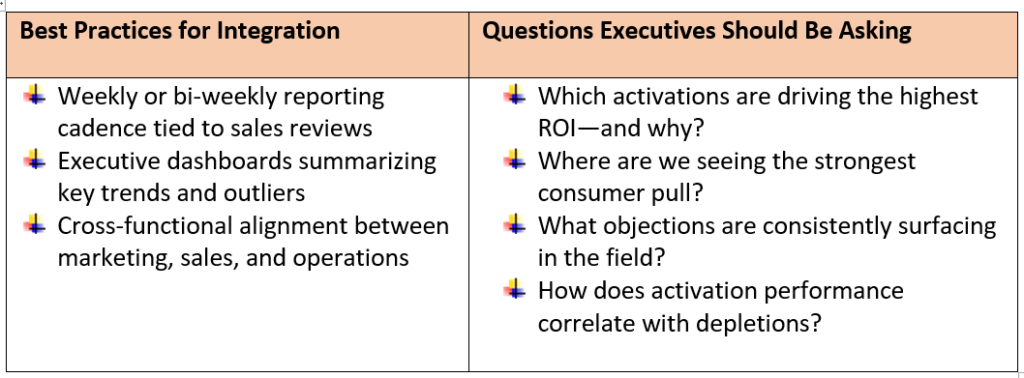
When leadership engages with field data regularly, it becomes a strategic asset, not an afterthought.
Common Pitfalls to Avoid
Even well-intentioned programs can fall short without the right approach.
Over-Collecting Data
Too many data points can overwhelm field teams and dilute focus. Prioritize metrics tied directly to decisions.
Delayed Reporting
Insights lose value when delivered weeks after execution. Real-time or near-real-time reporting is critical.
Lack of Alignment
If marketing, sales, and distributor partners are not aligned on goals, data becomes fragmented and underutilized.
Ignoring Qualitative Insights
Not all valuable data is numeric. Open-ended feedback often reveals the “why” behind performance trends.
Actionable Takeaways
- Define success upfront: Align on the metrics that matter before launching activations
- Standardize data collection: Ensure consistency across markets and teams
- Invest in technology: Use platforms that enable real-time, structured reporting
- Focus on insights, not just metrics: Translate data into clear business recommendations
- Share data across stakeholders: Strengthen collaboration with distributors and internal teams
- Create a feedback loop: Integrate field insights into ongoing strategy and planning
Conclusion: Elevating Activations Through Data
Field activations are no longer just about sampling—they are a critical source of market intelligence. Brands that treat them as such gain a clearer understanding of their consumers, stronger alignment with distributors, and more precise control over their growth strategy.
The shift from field data to executive insight requires structure, discipline, and the right tools. With a data-first approach and national execution capabilities, partners like Liquid to Lips help bridge that gap—ensuring that every activation contributes not just to immediate sales, but to long-term strategic advantage.