Executive Summary
Predictive analytics is transforming how beverage brands plan and execute in-market demos. By leveraging historical data, regional trends, and consumer behavior patterns, brands can optimize where, when, and how they deploy sampling teams. This approach reduces wasted spend, improves conversion rates, and informs broader commercial strategy. Companies that integrate predictive insights into demo planning can make smarter decisions at both tactical and executive levels.
Why Predictive Analytics Matters in Demo Planning
Beverage activations, from retail tastings to on-premise events, generate massive amounts of data. Traditional planning often relies on intuition, historical performance at specific accounts, or distributor recommendations. While these inputs have value, they rarely provide the full picture of market opportunity.
Predictive analytics allows brands to:
- Identify accounts or regions most likely to convert
- Forecast consumer engagement at demos
- Optimize sampling frequency and timing
- Allocate budgets with measurable ROI in mind
Industry estimate: Brands using predictive insights in demo planning see an estimated 15–25% increase in conversion efficiency compared to traditional approaches.
Key Data Inputs for Predictive Demo Planning
1. Historical Performance Data
Review past demos to identify:
- Accounts with the highest conversion rates
- Locations where trial leads to repeat purchases
- Product variants that resonate most with consumers
Example: A craft beer brand may find that suburban grocery stores consistently outperform urban convenience stores in repeat purchase rates.
2. Market and Consumer Trends
Integrate external datasets such as:
- Local population demographics
- Event foot traffic patterns
- Seasonal beverage preferences
These inputs help anticipate demand spikes and adjust demo schedules proactively.
3. Distributor and Account-Level Data
Distributors hold critical insights on inventory movement and sales velocity. Predictive models incorporate:
- SKU-level sales history
- Account-specific seasonal peaks
- Historical promotional responsiveness
Translating Predictive Insights into Action
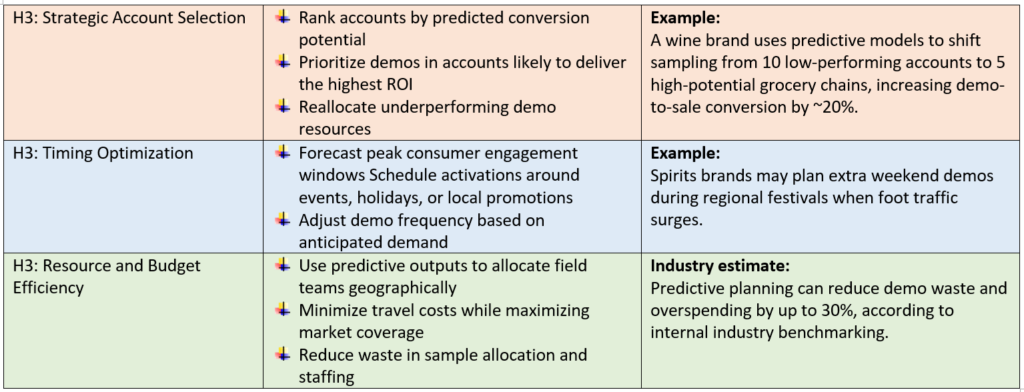
Predictive analytics is only valuable if it informs operational decisions. Consider these practical applications:
Integrating Technology for Scalable Insights
Manual planning and spreadsheets are inadequate for large-scale beverage activation programs. Modern brands leverage technology-enabled platforms to:
- Aggregate and analyze historical demo data
- Apply predictive models at the account and regional level
- Generate actionable dashboards for field teams and executives
Liquid to Lips serves as a data-first sampling platform, offering real-time dashboards, geo-tagged reporting, and integration with distributor sales data. This allows brands to scale predictive insights across hundreds of accounts nationwide while maintaining execution precision.
Building the Feedback Loop
Predictive analytics is not static—it improves with each activation cycle. To maximize value:
- Capture post-demo performance: Track conversions, repeat purchases, and consumer feedback
- Update predictive models: Incorporate fresh data to refine future planning
- Share insights across teams: Align marketing, sales, and distributor partners
Example: After a series of THC beverage demos, predictive adjustments identified new high-potential accounts, resulting in a 15% lift in overall demo effectiveness.
Common Challenges and How to Address Them
- Data Silos: Ensure field teams, distributors, and marketing share compatible datasets.
- Overcomplicated Models: Prioritize actionable insights over complex outputs.
- Execution Gaps: Predictive outputs are only useful if field teams follow recommended schedules and account prioritization.
Actionable Takeaways
- Leverage historical demo and sales data to identify high-potential accounts
- Incorporate market, seasonal, and demographic trends into predictive models
- Use predictive insights to optimize timing, frequency, and resource allocation
- Integrate technology platforms for real-time reporting and scalable execution
- Build a continuous feedback loop to refine models and improve ROI
Conclusion: Making Predictive Analytics Work for Beverage Brands
Predictive analytics transforms demo planning from reactive to strategic. By integrating field performance, market trends, and distributor insights into predictive models, beverage brands can maximize conversions, reduce costs, and provide executive teams with actionable intelligence. Partners like Liquid to Lips, with national execution capabilities and a technology-enabled, data-first approach, help brands turn predictions into measurable results—ensuring every demo contributes not just to immediate sales, but to long-term growth.