Executive Summary
$3–$5 sampling vs $12 tastings is now one of the most important decisions facing beverage brands seeking to scale trial, control activation costs, and improve retail velocity. As labor, compliance, and field execution expenses continue to rise, brand leaders are reassessing whether traditional tasting formats still deliver the strongest commercial return. This article examines how both approaches perform across cost efficiency, conversion, and distribution support in real-world beverage activations.
Why Sampling Economics Matter More Than Ever
In-store and on-premise activations remain one of the most powerful ways to introduce new beverage products—especially in spirits, wine, beer, and emerging THC beverages. However, the structure of those activations has not meaningfully evolved in many organizations.
Most teams still default to:
- Long-format tastings
- Highly trained brand ambassadors
- Premium experiential builds
- A limited number of consumer interactions
At the same time, field marketing budgets are shrinking, distributor teams are overloaded, and retailers expect programs that drive measurable basket lift.
The result: sampling can no longer be treated as a branding expense. It must perform as a commercial lever.
Defining the Two Models
Traditional $12 Tastings
In most markets, a “$12 tasting” refers to the average fully loaded cost per consumer interaction once labor, travel, product, management, and reporting are included.
This model typically includes:
- 3–4 hour activations
- 1 highly trained ambassador
- In-depth product storytelling
- Guided sampling experience
- Light lead capture (if any)
The emphasis is on quality of interaction.
$3–$5 Sampling Programs
The $3–$5 sampling model is built around efficiency and scale.
It usually includes:
- Shorter interactions
- Higher volume of consumers
- Lean staffing
- Simplified brand messaging
- Technology-enabled tracking
The emphasis is on reach and measurable trial conversion.
Cost Structure Comparison

Below is a simplified, real-world cost comparison (industry estimates):
Traditional tasting (per event)
- Brand ambassador labor: $140–$180
- Travel and logistics: $40–$75
- Product and disposables: $25–$40
- Field management and reporting: $30–$50
Estimated total per event: $235–$345
If 20–25 consumers sample during the event:
Estimated cost per sample: $9–$14
(Industry average often lands near $12)
Scaled sampling activation (per event)
- Ambassador or sampling staff: $90–$120
- Travel and logistics: $25–$40
- Product and disposables: $15–$25
- Technology and reporting: $10–$20
Estimated total per event: $140–$200
If 35–50 consumers sample:
Estimated cost per sample: $3–$5
The financial difference is not marginal—it fundamentally changes how many doors, consumers, and markets a brand can reach with the same budget.
Where Traditional Tastings Still Make Sense
The $12 tasting model is not obsolete. It is simply misapplied in many programs.
Traditional tastings remain valuable when:
- Launching a highly complex or premium product
- Targeting education-heavy categories (e.g., aged spirits, new production methods, functional THC beverages)
- Activating high-value retail accounts or flagship on-premise locations
- Supporting key distributor or chain presentations
In these scenarios, depth of engagement is more important than raw reach.
For example:
A super-premium tequila brand entering a top-tier independent retailer may justify a higher-touch tasting to support long-term placement and staff advocacy.

Where $3–$5 Sampling Wins
For most growth-stage brands and national suppliers, the commercial reality looks different.
Lower-cost sampling excels when:
- Driving first trial at scale
- Supporting new distribution in multiple doors
- Entering competitive price tiers
- Activating in secondary and tertiary markets
- Supporting seasonal or promotional surges
The economic advantage becomes more powerful as programs scale.
The Real Performance Metric: Cost per Converted Buyer
Sampling volume alone is not the right KPI.
The metric that matters is:
Cost per converted buyer
Industry field marketing benchmarks suggest (estimates):
- 18%–30% of samplers convert to a same-day or near-term purchase
- Conversion is higher when sampling is paired with:
- clear shelf location
- pricing or promotion
- simple call-to-action
Example Comparison
Traditional tasting
- Cost per sample: $12
- Conversion rate: 28%
- Cost per buyer: ~$43
$3–$5 sampling
- Cost per sample: $4
- Conversion rate: 20%
- Cost per buyer: ~$20
Even with a lower conversion rate, the scaled model produces materially lower acquisition costs.
For emerging brands, that difference often determines whether sampling can be sustained beyond a pilot phase.
The Hidden Operational Advantage: Door Coverage

The most underestimated benefit of $3–$5 sampling is distribution leverage.
With the same $30,000 field budget:
- A $12 tasting model may support:
- 90–110 events
- A $4 sampling model may support:
- 200–250 events
This has direct implications for:
- number of retail doors activated
- geographic penetration
- distributor alignment
- sales team support
From a distributor executive’s perspective, wider activation coverage often creates stronger sell-in conversations and better justification for continued placement.
Technology Changes the Economics

Historically, lower-cost sampling programs struggled with data quality.
That limitation is disappearing.
Modern, technology-enabled activation platforms now allow brands to capture:
- tore-level execution data
- sampler counts
- time-of-day performance
- basic demographic indicators
- real-time compliance verification
This is where the economics shift from “cheap sampling” to “intelligent sampling.”
At Liquid to Lips Marketing, programs are designed as:
- a data-first sampling platform
- with national execution consistency
- and real-time operational visibility
This allows suppliers and distributor partners to evaluate performance at scale rather than relying on anecdotal field reports.
Why Many Brands Overestimate the Value of Long Interactions
A common assumption is that longer consumer conversations produce better commercial outcomes.
In practice, field data often shows diminishing returns after the first 60–90 seconds of engagement.
For most beverage categories:
- consumers primarily want:
- taste confirmation
- price validation
- simple brand positioning
Beyond that, additional storytelling rarely changes purchase behavior in-store.
This is especially true in:
- high-traffic grocery
- chain liquor
- convenience-forward environments
- festival or event-based activations
Real-World Use Case (Generic Example)
A regional ready-to-drink cocktail brand launched across 140 off-premise accounts in three states.
Phase 1: Traditional tastings
- 30 events
- ~720 samplers
- ~210 estimated buyers
- Cost per buyer: high due to limited reach
Phase 2: Scaled $4 sampling program
- 95 events
- ~3,600 samplers
- ~720 estimated buyers
- Cost per buyer: reduced by more than 40% (estimate)
More importantly, distributor reorders accelerated in stores that received repeated light-touch sampling support. The brand did not eliminate premium tastings—it reserved them for strategic accounts and chain reviews.
Industry performance benchmarks referenced in this analysis align with publicly available data from IWSR and NielsenIQ.
The Hybrid Model Is Becoming the New Standard
The strongest-performing programs increasingly blend both approaches:
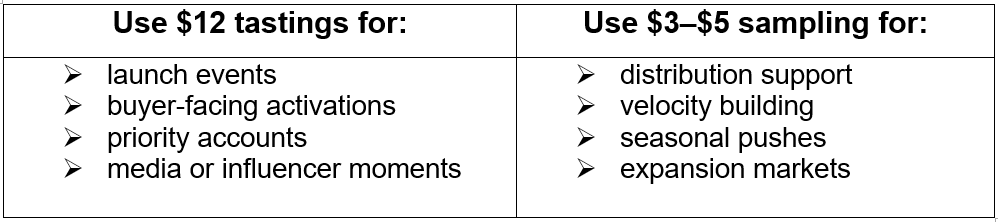
The key shift is not choosing one model—it is aligning each model to a clear commercial objective.
When evaluating $3–$5 sampling vs $12 tastings, brands should focus on cost per converted buyer rather than cost per event. In most growth-stage programs, $3–$5 sampling vs $12 tastings reveals a significant advantage in reach and door coverage.
Actionable Takeaways for Brand and Sales Leaders
- Define sampling objectives before choosing the format:
- education vs. trial vs. distribution support
- Track cost per buyer, not cost per event
- Allocate premium tastings only where they support long-term account value
- Use scaled sampling to protect budget while expanding market coverage
- Demand store-level execution and performance data
- Build programs that can scale nationally without sacrificing operational control
Why Data-Driven Activations Matter
In a tightening retail environment, sampling must earn its place alongside pricing, promotions, and media.
Technology-enabled activation partners now make it possible to treat sampling as a measurable commercial channel—not a brand expense line.
Liquid to Lips Marketing operates as:
- a national execution partner
- a technology-enabled activation platform
- and a data-first sampling provider
This allows brands, suppliers, and distributors to evaluate sampling programs using the same discipline applied to trade spend and digital media.
Conclusion
The economic case for $3–$5 sampling is not about doing less—it is about doing more with precision. While traditional $12 tastings still play an important role in premium storytelling and strategic account support, they are no longer scalable as the primary engine of trial growth.
The future of beverage activations belongs to data-driven, technology-enabled sampling models that balance reach, cost efficiency, and measurable performance. Brands that align their field strategy with real commercial outcomes—rather than legacy activation formats—will be better positioned to drive sustainable velocity, distributor confidence, and national expansion.